After watching Yoda's finish swivel video, i can say that the only difference between's "ben swivel" and "yoda's swivel" is that yoda is simply swiveling it back to the plane and STOPPING and letting the left wrist bend to the finish. Where as "ben's swivel" is swiveling it as much as the face will allow which would be looking at the ground.
Jim,
If there is enough time and sunshine next Thursday when we play, I'll show you the One and Only Super Duper Complete Hinge Action/Motion Finish Swivel Yoda Acid Test. Just need the Sun and about four clubs laid out on precise angles. There is more to it than the pictures can illustrate. Seeing it on the ground, club in your hand (similar to Ben in the sand) uncovers the illusions. Ted took photos of the dowel layouts and he may post them on the web-site someday.
After watching Yoda's finish swivel video, i can say that the only difference between's "ben swivel" and "yoda's swivel" is that yoda is simply swiveling it back to the plane and STOPPING and letting the left wrist re-cock to the finish. Where as "ben's swivel" is swiveling it as much as the face will allow which would be looking at the ground.
I feel very strongly about this issue of the Finish Swivel -- both the fact that it is absolutely essential and also that it absolutely can be overdone. I should know: I was taught Swivel Action at age 16 and didn't differentiate it from Hinge Action for the next twenty years. To bad for me, but it doesn't have to be that way for you. Not if I can help it.
It is exceedingly important to have the correct concept in order to Translate the Mechanic into its describable Feel. And that is the main reason I produced the differentiating Hinge and Swivel Action videos put up this morning.
Jim is right that I teach the Finish Swivel as advocated by Homer Kelley:
1. "After the selected Hinge Action has been executed, the Swivel is again useful for Snap Rolling the Hands into their On Plane Condition for the Finish." (2-G)
2. "But all players must Swivel -- actually rotate their Wrists -- into the "parallel to the Plane" position for the Finish after the Followthrough." (4-D-0)
But he also warns:
3. "Some players even intentionally execute Impact as exclusively a Swivel, making Clubface alignments extremely fleeting and erratic." (2-G)
[Bold in the above quotes by Yoda.]
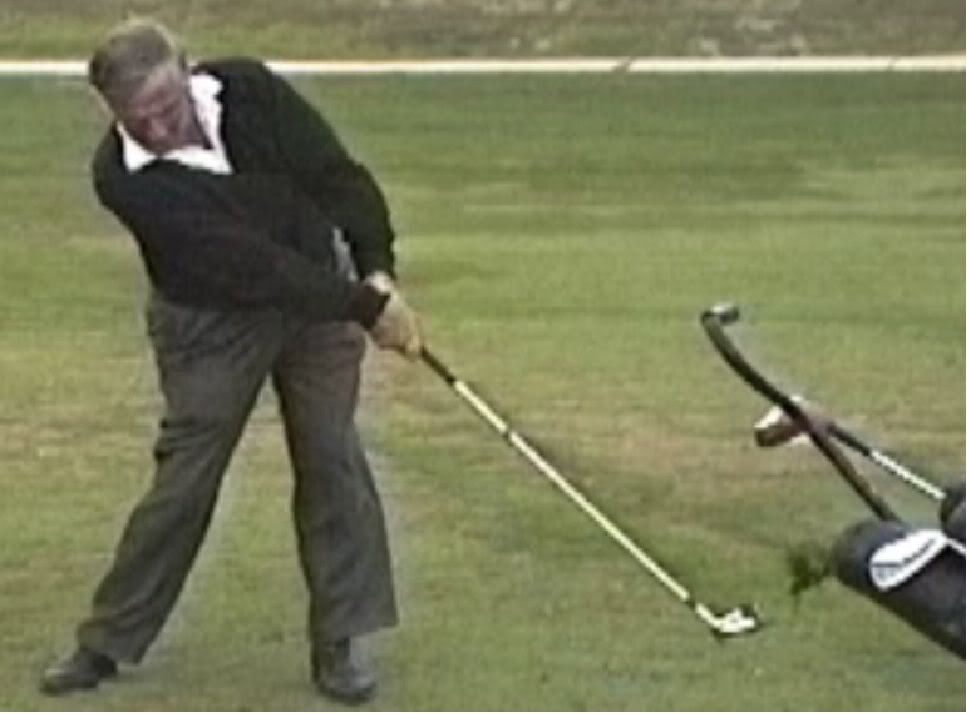
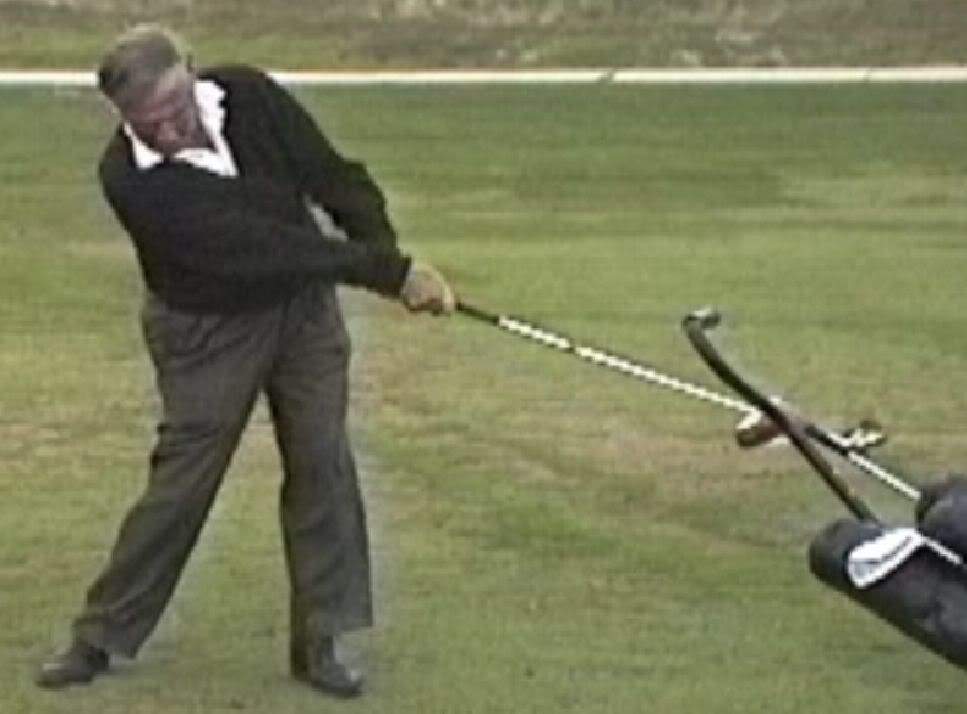
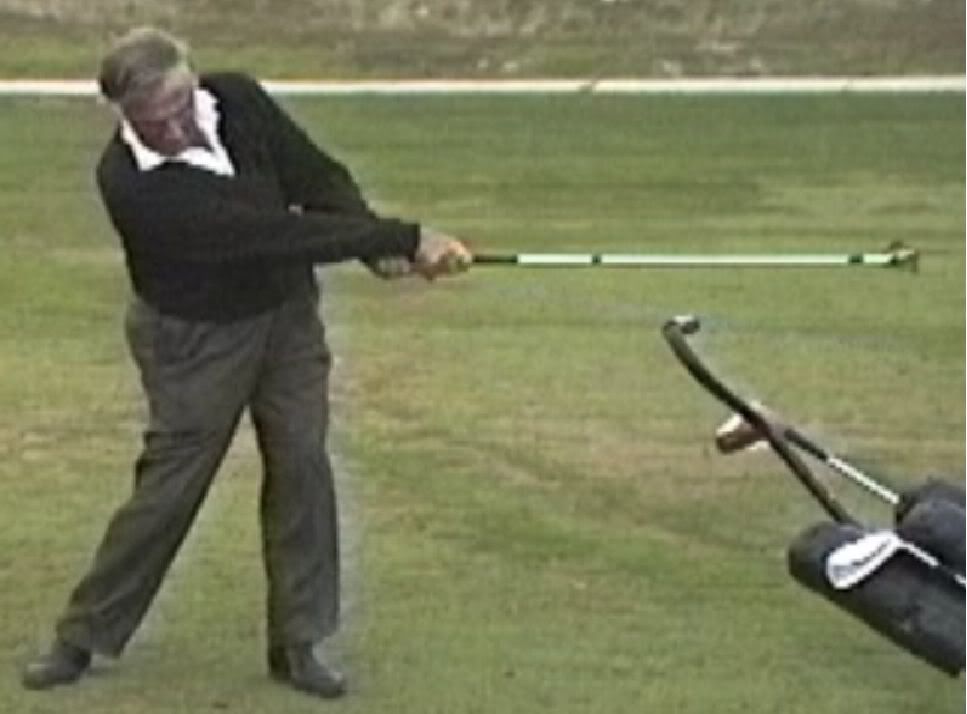
The first three photographs below (originally posted above by Tongzilla) illustrate an Over Swivel. Now, this particular Action may have been for a purpose or simply an error of Execution. Regardless, it is certainly something more than a Horizontal Hinge Action followed by an On Plane Swivel.
In the first photo -- the end of the Follow-Through (Both Arms Straight position with the Club approximately 45 degrees to the ground) -- the toe of the Club should be pointing 'along the Line'. Instead, it is well-Closed to that alignment, far beyond the "Vertical to the ground" alignment of Horizontal Hinge Action. In the second photo, the exaggerated Closing continues. Finally, in the third photo, with the Clubshaft parallel to the ground -- and On Plane (assuming it is also parallel to the Plane Line) -- the Clubface is facing directly toward the ground (and not towards the Plane). The same is true of the Flat Left Wrist. The back of the Hand points directly to the ground (rotated Under Plane).
Contrast these photos with those below extracted from my Finish Swivel video. At waist high (Photo 1) -- with Shaft On Plane parallel to the ground and Line -- the back of my Flat Left Wrist is parallel to the Plane, as is the Clubface. This is the correct On Plane Swivel Action.
In Photos 2 and 3, I deliberately chose a stop-action showing the back of my Flat Left Wrist similarly approaching -- but not reaching -- the Horizontal. The difference from the first sequence above is that this Action did not occur until much later in the Stroke (with the Hands chest-high and the Clubshaft Position well above the Hands). Even then, much (if not all) of this 'beyond the Plane' action occurred because my Right Shoulder comes Off Plane into the Finish. This 'high' Right Shoulder causes the On Plane Swivel to appear more exaggerated than it really is.
The Golfing Machine is all about Alignment Golf. This term appears twice in the first paragraph of the Preface and is virtually interchangeable with the term Geometric Golf that appears on the front cover. Likewise, LynnBlakeGolf.com is all about Alignment Golf. Know that this post is not about differentiating Instructors. Instead, it is about differentiating alignments.
Make sure you know exactly the required alignments. Then, do your best to execute them correctly.
That is all you can do.
And that is what you must do if you are to play your best Golf.
In introducing my post, I stated that the Alignments evident in this particular Stroke may have been intended and for a purpose. If that purpose was to hit a Straight Shot and the Ball went Straight, then that purpose was served. If the purpose was to hit a Hooked Shot and the Ball Hooked...or a Fade Shot and the Ball Faded...then that purpose was served.
But...
These are not the Clubface alignments of The Golfing Machine.
Respectful of the sensibilities involved, I closed my post stating its purpose as an Alignment issue, not as an Instructor (or personality) issue. I understand your loyalty to your Teacher and appreciate it. In fact, in many ways, I share it. But, I also ask that you honor the spirit of the piece and not mount a defense where there was no attack.
O.K. I thought hinge action only occurred from impact to follow through?
In the first photo Ben is past follow through. His left arm is bent and he is swiveling.
You stated that follow through is both arms straight and club about 45 degrees to the ground (I couldn't find that in the book). But, HK says both arms straight position as determined by the shoulder position at impact. In fact there are several pics in the book where they show follow through to be well before club about 45 degrees to the ground. 6-B-4-0 #2, 6-B-1-0 #3, 6-A-1 #3, 10-12-B #2
What I am saying is, Ben is past follow through at the point you say he is at follow through.
O.K. I thought hinge action only occurred from impact to follow through?
In the first photo Ben is past follow through. His left arm is bent and he is swiveling.
His left arm is bent, but it was also bent at impact - shortening the radius a guesstimated distance per 2-J-1 so thats not a good indicator for starters. The first photo shown on the site is the first frame in the entire sequence that the right arm appears to have completely straightened so its far better to take that as the indicator of the followthrough location for his stroke procedure. You are correct though that he is swiveling in the first photo...
What I am saying is, Ben is past follow through at the point you say he is at follow through.
And what I am saying is that, even though the Clubface may have been Square at the Point of Separation (1-L #17), these post-Impact photos are not the Clubface alignments of Hinge Action. They are the alignments of an Impact executed as an early Swivel (at the expense of a proper Hinge Action). And a Clubface facing the ground when the Clubshaft is parallel to the ground is symptomatic of an over Swivel. It should be facing the Plane.
Regarding whether or not Ben was at the end of the Follow-Through in the first frame, Mathew's analysis above is correct. There was no 'Both Arms Straight' in this Stroke, so we are left with the first frame where the Right Arm has become Straight. And my reference to '45 degrees to the ground, Clubface toe along the line' can be found in 2-G:
"Stop at the end of a short Chip Shot--the Club at about 45 degrees. With Horizontal Hinging, the toe of the Club will point along the Plane Line."
This is the 'swinging door' of the Horizontal Hinge Action -- the Clubface remaining Vertical to the Horizontal Plane through the Impact Interval. Ben's Clubface is Closing far more rapidly, indicative of Impact executed as a Swivel.
You are arguing positions. I am arguing alignments. We all need positions, but to be efficient, those positions must be geometrically-aligned. That is the whole premise behind G.O.L.F. -- Geometrically-Oriented Linear Force.
Yoda,
As I shared with you before, I absolutely love the finish swivel, and I personally have had great success with students after using a dowel to teach them the finish swivel. What is interesting is that everyone is so infatuated with impact that they try to create it instead of smoothly moving through it to finish.
I have really enjoyed this topic and reminds me to ask if you would share your experience last week at Marietta Golf Center when you and Ian watched as I introduced driver loft to a couple of students and how dramatically it affected their ability to not only hit the ball farther and straighter, but also achieve the elusive finish swivel. My contention is that players with insufficient driver loft try to lift, steer, flip, or whatever they can to achieve the proper flight. As we saw last week a "weaker" club may assist the student in achieving a "stronger" swing and shot.
I had a great time and enjoyed meeting Ian, look forward to your response.
"Regarding whether or not Ben was at the end of the Follow-Through in the first frame, Mathew's analysis above is correct. There was no 'Both Arms Straight' in this Stroke, so we are left with the first frame where the Right Arm has become Straight. And my reference to '45 degrees to the ground, Clubface toe along the line' can be found in 2-G:"--Lynn
I disagree...Watch the video. If you are going to classify follow through as right arm straight, it is straight the frame before and the toe is "along the line" and the shaft is "up the left arm" seems like a better spot to call follow through than having the first pic you have posted with the shaft pointed back at his sternum.
As far as 2-G, the way I read that sentence it is more of a suggestion to the student to visually see hinge action.
Homer defines Follow Through as I stated before 8-11 This section covers the interval between Separation (of Ball and Clubface) and the Both Arms Straight Position as determined by the Shoulder Position at Impact. Ben's "equivalent" of a straight left arm is bent (as I have noticed yours is in some videos I have of your swing)- I AM NOT KNOCKING THAT. Retief Goosen does it as did Lanny Wadkins and others.
The pics in the book of follow through have the club up the left arm, not middle of the arms.




 Linear Mode


