Pivot Lag. As soon as the Hips stop moving forward or slow, the Shoulders slow then Arms, Hands and Clubhead. #3 PP should have strong Pressure at least until Both Arms Straight. Driven by the Pivot.
Not sure if I am with you on the premise that when the hips slow down they slow down the shoulders, then the arms, hands, club, etc. As I understand it, swing jackets and other body motion software show a kinetic chain where the feet, then hips, then shoulders, etc have to slow down to pass on their momentum to the next "link" in the chain. This may not be a conscious movement, but it is what I believe happens.
What good is going fast if you can’t sustain the Lag. Besides, people have different speeds. People with fast Hips won’t hit the ball any farther unless they can move that Right Hip a long Way Through Impact.
Please keep in mind that Most Golfers (maybe 95%) do not move their Right Hip Far enough. You though, may have more than adequate Right Hip Travel. But, if you find yourself moving the ball back in your stance for Irons, then you probably don’t either and you simply have not learned to Pivot in a way that allows for one Ball Position. If you play the Ball back in your stance, then it’s because your Hands simply are not getting to the ball if played just behind Low Point. That’s a Pivot Problem.
I agree most golfers don't get their hips open enough at impact. I, too, am a fan of a forward ball placement (and a relatively wide stance). For what it's worth, I play a single ball position and a relatively wide, but varying, stance width.
First learn to Pivot, then learn to go faster, IF your Body can Handle it. Mine can't!!! I'm 6 feet tall, 200 pounds, and My Pivot is too powerful for my arms and hands to handle. I'm very Strong but my arms simply cannot handle the Pressure that my Pivot can put on them. My Hands know, and they Tell me to take it down a notch. Honestly, during my downswing, my Hands are Telling my Pivot to cool it.
Fair enough. I think each person's swing, and more importantly, their feels, are independent...you gotta listen to what your body tells you. I am 5' 10" 150 lbs, and have no problems with pivoting as hard as I can.
mrdock, I'm with you on the deal with Hogan's left shoulder going down....I would have to look at more pictures and video though, but I think in his later years (the 1967 swing in VJ's book for instance), his left shoulder actually goes down in the backswing, as he sets his secondary axis tilt and gets over his left leg. I don't think (but I'm not sure), that his shoulder goes down after that. Also, with more axis tilt, a relatively flatter shoulder turn still gets the right shoulder on plane...with no tilt, the shoulders have to turn very steeply to get on plane. Anyway, for me, when I do a VJ Trolio/Hogan type pivot, I feel like my right shoulder gets on plane pretty quickly.
After thinking on this a bit more, I realized I left out another important consideration regarding the pivot. The pivot has to interact with the ground....zone 1 is the only zone that comes in contact with the ground, and the power and speed of the pivot has to be developed from the ground up. If you try to pivot with one leg in the air, you can't go to hard or to fast...you need to be firmly connected to the ground. Also, I have found that you can generate a lot of rotational force by getting down into the ground and then rebounding up...reminds me a bit of Percy Boomer, opposing forces, gotta get down to get up.
Bucket, I would be interested to hear your thoughts on how the pivot interacts with the ground. As I understand it, the boys on the "dark side" also like the idea of getting down and springing up to generate rotational force. What have you learned about that?
Also does this idea of getting down and using the ground, then springing up, fall into the sacred snare of bobbing? Did Hogan bob? Did Snead? Does it matter? Why or why not?
Have you decided what you wanted to know when you posted this thread titile?
We are starting to discuss a lot of different elements about the pivot. How it feels to some of us, where the force originates, etc. If left unchecked, this thread may spiral out into a lot of opinions without much consensus or clarity.
But I still want to know what Bucket meant by fundamental alignments of a good pivot?
Have you decided what you wanted to know when you posted this thread titile?
We are starting to discuss a lot of different elements about the pivot. How it feels to some of us, where the force originates, etc. If left unchecked, this thread may spiral out into a lot of opinions without much consensus or clarity.
But I still want to know what Bucket meant by fundamental alignments of a good pivot?
Then we can move forward. I think.
Bucket? You have the floor.
UPP in snowy Ohio
I still don't think we have defined:
A. All the functions of the pivot
B. The Components that make up the pivot
C. Sequence of Movement in the Pivot
D. Relation of Pivot to Plane Angle
E. Relation of Pivot to Plane Line
F. Relation of Pivot to Hand Path
G. Relation of Pivot to Clubface
E. Relation of Pivot do Low Point
Does that get us back to the task at hand?
So let's start with Function
1. Deliver the Power Package to the desired Impact Hand Location with the corresponding amount of Shaft Lean
2. Develop Angular Momentum and/or Support of Muscular Thrust
3. Allow the club to satisfy desired Plane Line/Angle requirements via the amount of Axis Tilt
4. Produce the desired Hinge Action and comply with Grip Type Requirements
5. Produce the necessary amount of Pivot Lag (for full power shots from the ground up i.e. Swinging from the Feet) Transfer momentum from "joint segments"
6. Balance the Machine
7. Have a Center that produces a consistent Low Point and Angle of Attack
That's my 5 minute stab at it . . . in no particular order.
After thinking on this a bit more, I realized I left out another important consideration regarding the pivot. The pivot has to interact with the ground....zone 1 is the only zone that comes in contact with the ground, and the power and speed of the pivot has to be developed from the ground up. If you try to pivot with one leg in the air, you can't go to hard or to fast...you need to be firmly connected to the ground. Also, I have found that you can generate a lot of rotational force by getting down into the ground and then rebounding up...reminds me a bit of Percy Boomer, opposing forces, gotta get down to get up.
Bucket, I would be interested to hear your thoughts on how the pivot interacts with the ground. As I understand it, the boys on the "dark side" also like the idea of getting down and springing up to generate rotational force. What have you learned about that?
Also does this idea of getting down and using the ground, then springing up, fall into the sacred snare of bobbing? Did Hogan bob? Did Snead? Does it matter? Why or why not?
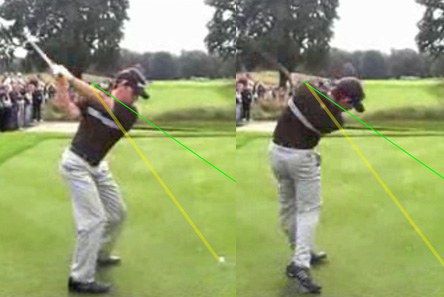
I gotta believe that there are some vertical forces involved for sure . . . the straightening of the left knee allows the hip to turn and go forward (I think Mike O may be able to add to this since he's chopped many a person up) . . . straightening would certainly have a vertical component. Also I would think that it would depend on your Delivery Line as well. A cross line motion is going to be much more across I'd think thus more horizontal forces than vertical. An arc of approach procecure would be more vertical and rotational I'd think.
I see vertical forces in these pics . ..
__________________
Aloha Mr. Hand
Behold my hands; reach hither thy hand
Last edited by 12 piece bucket : 02-12-2008 at 10:45 AM.




 Linear Mode


