
|
Was Nicklaus off plane?
1 Attachment(s)
Homer wrote "The right forearm of every hacker comes into impact too high - pointing beyond the delivery line during the Downstroke" (2-F)
Here is a picture of Nicklaus at the delivery position. The right forearm points outside the ball, what am I missing? I ask because I use the TSP like Nicklaus and my arm is very similar at the same position. I asked someone else knowledgeable with teh golf swing and they stated that they teach all their students to have the right forearm on plane at the delivery position because you have to rely on wrist action into impact when it is not. I just am wondering if the book is correct and its a fault that I should attempt to fix. |
Quote:
 When HK said that the Right Forearm of every Hacker comes in too High, he's referring to the #3 PP not tracing the Delivery Line. There are many Planes. Swing Plane, Shaft Plane, Left Arm Flying Wedge, Right Arm Flying Wedge, etc. The only instance when the Right Forearm is on the actual Swing Plane at Release, is when the Swing Plane is the Elbow Plane and the Elbow and Hands are on the Plane. In TGM, in all instances, when we say that the Right Forearm (right forearm flying wedge) is On Plane, we mean that it is at Right Angles to the Left Arm Wedge Plane. This includes the Elbow Plane. Quote:
6-B-3-0-1 THE FLYING WEDGES illustration is below on the Right. The Elbow Plane version is on the Left. Note that the Illustrations are at the Release.  |
Great description and wonderful visuals Daryl!
Should the text on the picture read Cocked Left Wrist and Level Left Wrist instead of bent and flat? Thanks, Kevin Quote:
|
Quote:
|
Quote:
|
1 Attachment(s)
Thanks Daryl and Bucket, thats why I posted this picture here because I knew you guys would have the goods :salut:
Here is my pic at the same spot right now, I am playing good golf but as usual if its not perfect I am always looking to get better. For me I really feel the pp#3 turn down and drive into the ground just in front of the ball from the position to impact. |
Your Right Forearm is under the Inclined Plane as it should be there. Imagine the Inclined Plane as running from the ball up to where your right shoulder was when it was turned, that'd be a TSP. Looks like your #3pp would be right on it which is good , really good. The Right Forearm is on the Inclined Plane at Impact (and Fix), but maintains the RFFW , the Plane of the Right Wrist Bend throughout the entire swing.
I'm thinking the confusion lies in what Homer meant by "coming into impact". The photo of Jack is prior to that , more Release than "coming into Impact". The longer you keep your Right Hand flat to the Inclined Plane (on the underside of the plane) the later the Release Point and the more right arm you will have for the ball..........this is Hitter talk here. It is the Right Elbow that you Load and the Right Elbow that you Release. (Forget about loading the Left Wrist and maintaining #2 Angle that is sissy stuff). The Right Forearm will stay under the Inclined Plane until Release at which time it will start to rotate up onto the Inclined Plane assuming RFFW maintenance. If you lose your RFFW alignment then as Homer was referring to it will not point at the Plane Line coming into Impact..........very structurally week in a mechanical sense and lacking Direction , Tracing ability in a Geometric sense. The #3pp, the entire Right Forearm Flying Wedge relates to both Thrust and Direction. Take an iron, grip it and put the head against something wont move.......the edge of mat, a door frame ,the ground even.........and try to bend the shaft as much as you can. Notice how you automatically adopt a RFFW alignment! Its structure plus. (You'll also probably feel the left thumb wanting to go to the aft of the grip and the #3 pp as well cool eh?) Anyways this Structure of the RFFW is what the Hitter thinks about taking into the ball, smashing the ball to smithereens with it. The iron glove of the Hitter! What the Hitter thinks about if he aint hungry or needs to go to the bathroom. Our Swinger buddies have it too but dont think about so much to their detriment maybe. They're normally busy fretting over their pretty little left wrist cock delay or something..... |
Quote:
|
Quote:
Its the Right Shoulder that takes the Bent Right Arm , the fully loaded Right Elbow for the Hitter down to its Release Point! There is no other way! Think about it. But the Right Shoulder must travel Down Plane. See 10-13-A Standard Shoulder Turn after you digest the TSP. Thanks to Yoda I now think about the business of the Backswing as being an effort to get the Hands and the Right Shoulder on the TSP at Top. They dont start out that way , together on that Plane at Address, they travel different paths to get there assuming a Right Forearm Takeaway. But that is the goal at Top! Cant do it with a Shoulder Turn Takeaway! You need to have your mind in your Hands. As for the under plane stuff after impact........it could be camera angle, it could be real. If its real, your divots probably point to the left. |
Quote:
The Illustrations show the Geometry at the Release Point. At Impact the Left Wrist is Level. I should have shortened the Clubs more in the illustration to be less confusing. |
Quote:
I want to fix some of the things that are creating compensations now that I have a reasonable repeating motion. The Nicklaus pick was one thing I picked out, I have several notes I made from the Book that I have questions about compared to my pattern. your comments about the shoulder are spot on when I watch my videos, my right shoulder tends to go down below the TSP and hang back rather then move downplane. I think this can lead to some throwaway issues. I am re-cataloging all my components per the checklist to see how they fit, does anyone do this as laid out in the book? I know one thing, now that I actually understand the Book a lot better some of my preconceived notions are just flat out wrong about my swing. |
Getting outside going back is pretty common, especially for guys who learned how to rock the triangle , shoulder turn the two stiff arms back in Startup. I never fixed that, try as I might, until I started bending my Right Arm with Yoda. The RFT is Fanning and Bending. When does the Bending start I asked him once. "How about right away" was his reply.
To get a feel for this and to reinforce it I really, really like a piece of advice Lynn gives in his the Premium Brain Gay video. Basically Brian's pre shot waggle is a fanning of the right forearm done without any shoulder turning what so ever. The actual swing can have them both going at the same time but this waggle for me anyways , turns on the RFT and turns off my Shoulder Turn Takeaway with its left side push away tendency. Practice this at home with your club up against but not quite touching some base board. That old frozen right elbow will take it immediately outside every time and you'll crash the club into the base board. Its frustrating but the fix is a bending right elbow and all that it can provide. Which is a lot. See the last paragraph in 7-3. Homer did refer it to as the Magic of the Right Forearm. But you'll need extensor action if you dont already have it to realize it all. Some will say that the backswing doenst matter really, that its the downswing where the rubber meets the road etc etc. Which is true but only to a point. To employ the wrong muscles in Startup is to set a motion a chain of events that will effect Impact. Its harder to have a proper Inside Out Impact 2-J-2 without a proper Ouside-In Startup. Actually the first paragraph in 2-J-2 is worth the price of the book or more. To not understand the geometry discussed there is to Steer the path of the clubhead "straight". Which will give you a divot that points to the left and a Bent Plane Line. Have you goofed around with Single Wrist Action? Then you wont even need to think about Startup Swivel! It'll just happen on its own as the right side pulls the left along. Its weird but the left side centric Startup is turning and cocking where as a right side centric view, perception of things, has little if any turning. And so I just put my brain in my right side and let the left follow along and do whatever it needs to do on its own.........no thoughts about left side turning. |
Very nice Daryl!
Is the uncocking of the left wrist and the roll of the left wrist or sternum or shoulder or cinnamon?
Quote:
|
Quote:
Here is a Mickelson photo, he uses the TSP, is he below plane looking at your pic and at pic 5 numbered? (photo courtesy of Jeff Mann). 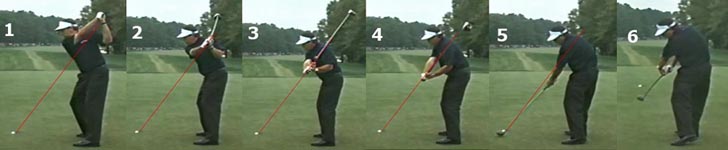 |
Quote:
He's obviously not on an Elbow Plane. I haven't ever looked at his swing before, but his leading arm is not dropping straight downward like it would with a Plane Shift to the Elbow Plane. Thank you for posting this great sequence picture. He's a Hands Controlled Pivot TSP Swinger. I never knew that. His right elbow never stops moving down plane and his leading arm is blasting off the chest from frame 3 to frame 4. 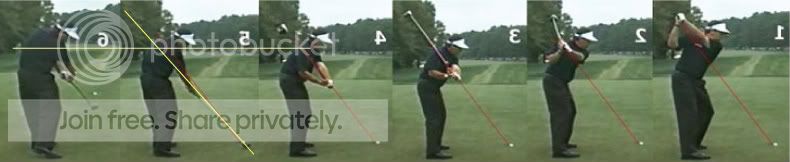 |
I agree, I think a lot of his blast off comes from swinging left handed yet being a right handed person. I know I played baseball that way and utilized the same way to generate power. The left hand was just there for the ride, no power. You can see Mickelsons left hand barely stays on the club.
Yet I cannot generate that same feeling playing golf right handed. I don't feel any real blast off. |
Quote:
|
Quote:
|
1 Attachment(s)
I dont have that swing itself, I had this one from Riviera a couple years ago, its probably the best swing I have seen him make so it probably wont help in you, as you can see he is dead nuts on plane (club is tough to see).
|
Quote:
Would you say dead nuts on plane on the elbow plane? |
1 Attachment(s)
Not to my understanding, the hands from the top move right along, I mean never leaving, the line I drew for the TSP, the right forearm when he gets to the delivery position gets very close to the elbow plane (between the TSP and Elbow Plane) but the hands and clubhead are on the TSP.
|
Quote:
|
1 Attachment(s)
Quote:
or is he making the right move by having the clubhead on the elbow plane. I just checked and I do the same thing. |
Quote:
|
Studying Brian Gay's swing. With shorter clubs, I see his hands (pp#3) go exactly down the turned shoulder plane. The club head is underneath making a sort of eliptical crescent shaped path. With longer clubs, his hands seem slightly underneath the TSP but the club head makes the same eliptical path. Is this the result of lag pressure and pivot??? Thanks.
|
Quote:
Remember the shaft is only a rough proxy for plane compliance. It rotates around the sweetspot not vice versa. Its the #3pp and it's sense for the Lag of the Sweetspot Plane, the longitudinal center of gravity and the Delivery Line that really matter. That feeling in your Hands, #3pp is the Sweetspot! Golf's secret. |
Quote:
You can have "inside out" impact on any of the "useful" planes cant you? The amount of "inside out" decreases as the plane angle steepens............but the Down increases......... I dunno. |
Quote:
|
Quote:
 http://www.youtube.com/watch?v=4tjrAnidTu4&feature=PlayList&p=CD5CB6C660E A0F3C&playnext_from=PL&playnext=1&index=12 This may be tsp all the way . . . http://www.youtube.com/watch?v=B1l0W...eature=related |
1 Attachment(s)
I see what your talking about, I think. But, is that a brief moment of non planar motion or a brief moment where its difficult to see the plane?
I can imagine Freddy as still having his club on an Inclined Plane there. Hard to say for sure. With Cink, the plane is more evident just before or after that point in the swing. So, wouldnt it be logical for it be on plane there too? I dunno. Maybe Daryl can test this out on his glass plane board. Is Freddy's club on plane? You'd have to figure out where his plane line is first........Does he normally set up with his feets open? http://www.lynnblakegolf.com/forum/a...d=127652782 0 |
He's lined up for a Draw. 10-5-E CLOSED-CLOSED |
Quote:
|
Quote:
 |
| All times are GMT -4. The time now is 05:22 AM. |