LynnBlakeGolf Forums

LynnBlakeGolf Forums (http://www.lynnblakegolf.com/forum/index.php)
-   The Golfing Machine - Advanced (http://www.lynnblakegolf.com/forum/forumdisplay.php?f=17)
-   -   The most important alignments in the uncompensating swing. (http://www.lynnblakegolf.com/forum/showthread.php?t=3287)

lekommend 08-23-2006 03:51 AM

The most important alignments in the uncompensating swing.
 
Please help me for more understanding some other exactly defined components of the golf swing as Homer Kelley would agree to.

1. what are considered the most important alignments in the uncompensating swing? and
2. How does a golfer maintain them throughout the swing?

Golf is frustrating when no answer is available, the answer that is simple to understand and without omissions.

Thanks in advance to LBG TGM qualified Instructor here and anyone who shared for clarification. :salut:

tongzilla 08-23-2006 06:09 AM

I'll take the bait for the first part of your question.
  • Flat Left Wrist from Start Up to Follow Through
  • Right Forearm and Clubshaft Tracing the Straight Plane Line during Release
  • The perpendicular relationship of the Flying Wedges: the Flat Left Wrist and Level Right Wrist
  • An "On Plane" Right Shoulder from Start Down to Follow Through to give the right amount of Axis Tilt and Hip Slide
  • All Pivot Components moving parallel to your selected Delivery Line (usually the Plane Line) at Start Down
  • A fixed Pivot Center
  • A 10-2-B Grip with no wobble in Clubshaft attachment during the entire motion

bts 08-23-2006 06:39 AM

Quote:

Originally Posted by lekommend
Please help me for more understanding some other exactly defined components of the golf swing as Homer Kelley would agree to.

1. what are considered the most important alignments in the uncompensating swing? and
2. How does a golfer maintain them throughout the swing?

Golf is frustrating when no answer is available, the answer that is simple to understand and without omissions.

Thanks in advance to LBG TGM qualified Instructor here and anyone who shared for clarification. :salut:

1. The head.

2. "Sustain the lag" with a rotating, spinning or turnning pivot.

EdZ 08-23-2006 10:03 AM

Quote:

Originally Posted by tongzilla
I'll take the bait for the first part of your question.
  • Flat Left Wrist from Start Up to Follow Through
  • Right Forearm and Clubshaft Tracing the Straight Plane Line during Release
  • The perpendicular relationship of the Flying Wedges: the Flat Left Wrist and Level Right Wrist
  • An "On Plane" Right Shoulder from Start Down to Follow Through to give the right amount of Axis Tilt and Hip Slide
  • All Pivot Components moving parallel to your selected Delivery Line (usually the Plane Line) at Start Down
  • A fixed Pivot Center
  • A 10-2-B Grip with no wobble in Clubshaft attachment during the entire motion

Nice list Leo ;)

To add to it, the shoulder line is one of the most important for all shots IMO because the hands will tend to follow the shoulders. If you maintain the flying wedges and have good shoulder alignment, you won't be far from your target. Especially important in putting - learn to key on your shoulders.

12 piece bucket 08-23-2006 10:52 AM

What is an uncompensated swing?

birdie_man 08-23-2006 11:28 AM

Good question...how would you define it?

...

Leo....good list man.

...

I'll add- perfect balance on every shot....from Address to the Finish. A stable base. (think waist-down)

EdZ 08-23-2006 11:43 AM

Quote:

Originally Posted by birdie_man
Good question...how would you define it?

An uncompensated swing - The most efficient application of force, based on the laws of physics, geometry and anatomy.

birdie_man 08-23-2006 12:11 PM

But that is debateable, no?

Thom 08-23-2006 03:01 PM

Quote:

Originally Posted by tongzilla
I'll take the bait for the first part of your question.
  • Flat Left Wrist from Start Up to Follow Through
  • Right Forearm and Clubshaft Tracing the Straight Plane Line during Release
  • The perpendicular relationship of the Flying Wedges: the Flat Left Wrist and Level Right Wrist
  • An "On Plane" Right Shoulder from Start Down to Follow Through to give the right amount of Axis Tilt and Hip Slide
  • All Pivot Components moving parallel to your selected Delivery Line (usually the Plane Line) at Start Down
  • A fixed Pivot Center
  • A 10-2-B Grip with no wobble in Clubshaft attachment during the entire motion

Nice list Tongzillium
Sorry if I'm threadjacking but....
I've just had an AHA-moment reading the third sentence.
The perpendicular relationship of the Flying Wedges: the Flat Left Wrist and Level Right Wrist.
Isn't it right that if you keep this relationship the right elbow position will follow the hingeaction:
-so if your're swinging with horizontal hinging, you'll turn the flat left wrist to the plane, that'll automatically put the right elbow in pitch position.
-and if you're hitting with angled hinging, you'll turn the flat left wrist less, and the perpendicular level right wrist will automatically put the right elbow in punch/push position.

Am I right?

....and now back to the important alignments in the uncompensated golfswing

ChrisNZ 08-23-2006 05:13 PM

Quote:

Originally Posted by tongzilla
I'll take the bait for the first part of your question.
  • Flat Left Wrist from Start Up to Follow Through
  • Right Forearm and Clubshaft Tracing the Straight Plane Line during Release
  • The perpendicular relationship of the Flying Wedges: the Flat Left Wrist and Level Right Wrist
  • An "On Plane" Right Shoulder from Start Down to Follow Through to give the right amount of Axis Tilt and Hip Slide
  • All Pivot Components moving parallel to your selected Delivery Line (usually the Plane Line) at Start Down
  • A fixed Pivot Center
  • A 10-2-B Grip with no wobble in Clubshaft attachment during the entire motion

I'm unsure about the second item - I'd say number three pressure point (and clubshaft) tracing through release and right forearm on plane at impact. I think this discussion may have been had before!

EDIT:

Shouldn't be so quick to type - Tongzilla is right and I am wrong. What I mean (I think) is that while the right forearm is tracing it need not be on the same plane as the clubshaft until impact (particularly with the turned shoulder plane).

Chris

drewitgolf 08-23-2006 06:36 PM

Shopping List
 
Quote:

Originally Posted by tongzilla
I'll take the bait for the first part of your question.
  • Flat Left Wrist from Start Up to Follow Through
  • Right Forearm and Clubshaft Tracing the Straight Plane Line during Release
  • The perpendicular relationship of the Flying Wedges: the Flat Left Wrist and Level Right Wrist
  • An "On Plane" Right Shoulder from Start Down to Follow Through to give the right amount of Axis Tilt and Hip Slide
  • All Pivot Components moving parallel to your selected Delivery Line (usually the Plane Line) at Start Down
  • A fixed Pivot Center
  • A 10-2-B Grip with no wobble in Clubshaft attachment during the entire motion

Excellent list, Tong. Wrap them up in the "Warmth of Educated Hands " and you won't be far from your target.

Peter Croker 08-23-2006 07:33 PM

Uncompensated Swing
 
Quote:

Originally Posted by EdZ
An uncompensated swing - The most efficient application of force, based on the laws of physics, geometry and anatomy.

Good answer EdZ!

Also I believe with an "Uncompensated swing" the alignments allow for maximum efficiency of power applied going into the ball plus the least amount of stress on the body parts.

Here are six alignments within the "Address" that I have found allow for maximum use of centrifugal force and least need for timing to hit the ball to the target.

1.The Left Wrist to the Club Shaft.
2.The left Wrist to the clubface.
3.The Club Shaft to the body center of gravity.
4.The Elbows to the hips.
5.The Spine to the ground.
6.The Clubface and Body to the ball’s target.

With these alignments in place and with a correct "pushing" action on the "pressure points" in the hands, all other alignments that are involved in the "Uncompensated Swing" are possible'
Hope this helps.

Kind regards,
Peter Croker:)

Mathew 08-23-2006 07:34 PM

"An "On Plane" Right Shoulder from Start Down to Follow Through"

Impossible....

Think of it this way - the left arm and clubshaft are inline at followthrough.... thus the left arm is onplane and if this straight line is onplane this means the left shoulder is onplane.... Ok now think if the right shoulder is onplane at followthrough which by definition is both arms straight... both shoulders must be onplane, now if both shoulders are onplane and lets say for simplification purposes, you are using the between the shoulders pivot center point which you are a fan of anyways...

Now with this information imagine the stroke in reverse from follow through backwards. Both shoulders are onplane - the point between the shoulders is onplane - now as the right shoulder goes back to the top ... how can the left shoulder ever leave the inclined plane - hint hint it can't....

The onplane right shoulder movement occurs during the initial startdown to throw the primary lever assembly via creating a pressure at pp4 to drive it into impact..... it cannot stay onplane till followthrough....

ChrisNZ 08-23-2006 08:58 PM

Quote:

Originally Posted by Mathew
"An "On Plane" Right Shoulder from Start Down to Follow Through"

Impossible....

Think of it this way - the left arm and clubshaft are inline at followthrough.... thus the left arm is onplane and if this straight line is onplane this means the left shoulder is onplane.... Ok now think if the right shoulder is onplane at followthrough which by definition is both arms straight... both shoulders must be onplane, now if both shoulders are onplane and lets say for simplification purposes, you are using the between the shoulders pivot center point which you are a fan of anyways...

Now with this information imagine the stroke in reverse from follow through backwards. Both shoulders are onplane - the point between the shoulders is onplane - now as the right shoulder goes back to the top ... how can the left shoulder ever leave the inclined plane - hint hint it can't....

The onplane right shoulder movement occurs during the initial startdown to throw the primary lever assembly via creating a pressure at pp4 to drive it into impact..... it cannot stay onplane till followthrough....

Disagree - does anyone believe the downswing is a simple pivot around the spine? Isn't this necessary for your argument to hold?

Chris

Mathew 08-23-2006 09:26 PM

Quote:

Originally Posted by ChrisNZ
Disagree - does anyone believe the downswing is a simple pivot around the spine? Isn't this necessary for your argument to hold?

Chris

This is a power package issue and you if try to draw an onplane right shoulder in 3d with the primary lever assembly being inline at followthrough, you'll see exactly what I mean.

tongzilla 08-23-2006 09:46 PM

De-fogging: Flying Wedges, Hinge Action and Basic Stroke Elbow Location
 
Quote:

Originally Posted by Thom
Nice list Tongzillium
Sorry if I'm threadjacking but....
I've just had an AHA-moment reading the third sentence.
The perpendicular relationship of the Flying Wedges: the Flat Left Wrist and Level Right Wrist.
Isn't it right that if you keep this relationship the right elbow position will follow the hingeaction:
-so if your're swinging with horizontal hinging, you'll turn the flat left wrist to the plane, that'll automatically put the right elbow in pitch position.
-and if you're hitting with angled hinging, you'll turn the flat left wrist less, and the perpendicular level right wrist will automatically put the right elbow in punch/push position.

Am I right?

I think you got a few concepts mixed up here: The Flying Wedges, Hinge Action, and the Basic Stroke Elbow Locations at Release.

The relationship of The Flying Wedges with itself (the Left Arm Wedge and Right Forearm Wedge) are the same whether you’re Hitting or Swinging. In other words, you should always have a Strong Single Action Grip (10-2-B) with a Flat Left Wrist and Level Right Wrist from Start Up to Follow Through. However, the relationship of The Flying Wedges (as a whole) to the Inclined Plane may differ between Hitting and Swinging.

All differences between Hitting and Swinging (including Hinge Action and Elbow Location at Release) essentially stems from their different Acceleration methods -- Longitudinal (Pull) for Swinging vs Radial (Push) for Hitting. And it is because Swingers need to Drag Load (10-19-C) the Club that they need to use Standard Wrist Action (10-18-A) which gives the Pitch Basic Stroke Elbow.

So, I’d say your concept that the Left Wrist is “turned less” with Hitting than Swinging is right, but you are confused about why such differences occur.

You are almost there, I hope this post will clear some fog.

ChrisNZ 08-23-2006 10:50 PM

Quote:

Originally Posted by Mathew
This is a power package issue and you if try to draw an onplane right shoulder in 3d with the primary lever assembly being inline at followthrough, you'll see exactly what I mean.

I'm still unconvinced...

Say you did keep the right shoulder onplane to followthrough, and the primary lever assembly ended up inline, in what way would you be off plane (e.tg. over/under etc), or where would the left shoulder be?

Chris

Mathew 08-23-2006 11:01 PM

Quote:

Originally Posted by ChrisNZ
I'm still unconvinced...

Say you did keep the right shoulder onplane to followthrough, and the primary lever assembly ended up inline, in what way would you be off plane (e.tg. over/under etc), or where would the left shoulder be?

Chris


You could draw that one picture in a position - but just tell me how your going to get there. If the right and left shoulder are on a plane any line between that point is going to be onplane too. So if you use a point between the shoulders center for simplicity - that will be onplane too(not quite true but close enough for our purposes).

Now if the stationary point stays onplane - the right shoulder stays onplane - how can the left shoulder leave that plane. Now try to visualise the shoulder motions and ask yourself, how can you have a top of the backstroke where this could happen....it can't....

ChrisNZ 08-23-2006 11:16 PM

Quote:

Originally Posted by Mathew
You could draw that one picture in a position - but just tell me how your going to get there. If the right and left shoulder are on a plane any line between that point is going to be onplane too. So if you use a point between the shoulders center for simplicity - that will be onplane too(not quite true but close enough for our purposes).

Now if the stationary point stays onplane - the right shoulder stays onplane - how can the left shoulder leave that plane. Now try to visualise the shoulder motions and ask yourself, how can you have a top of the backstroke where this could happen....it can't....

Independent movement of the shoulders? They are not a single T-bar. In fact this independent movement need not even occur during the downswin. If both shoulders are forward at the top then they curve forward from the spine. I agree any point between the shoulders would need to be on plane, just not that the spine would need to be between the shoulders - in a linear fashion that is!

Mathew 08-23-2006 11:26 PM

I know there is shoulder flexability which is why I said it was close enough for our purposes....

Just test yourself on researching shoulder motions and see what you find out....

It provides the acceleration for a good part of the downstroke but eventually it has to come off the plane.....

tongzilla 08-23-2006 11:54 PM

These were made by Hunter and approved by Lynn (Yoda).


Yoda 08-24-2006 12:37 AM

Hunter's Stickmen
 
Quote:

Originally Posted by tongzilla

These were made by Hunter and approved by Lynn (Yoda).

Hunter made a valuable contribution to the site and golfdom with his Hitting and Swinging Stickmen and the concepts they convey. They are completely his work, unedited (or "approved") by me, and they stand on their own considerable merit. Any questions as to their accuracy should be directed to him. They are a product of his own effort to 'get it right,' and I am sure he would welcome critical comment.

tongzilla 08-24-2006 02:36 AM

Quote:

Originally Posted by Yoda
Hunter made a valuable contribution to the site and golfdom with his Hitting and Swinging Stickmen and the concepts they conveyed. However, at no time were they submitted to me for "approval" and 'sign-off.' They are completely his work, unedited by me, and they stand on their own considerable merit.

Yoda, sorry about that. By "approval", I meant your praise of his work.

For example:

Quote:

Originally Posted by Yoda
I'll repeat what I said about the Hitting Stickman:

Wow!

Great stuff, Rob. This is work unprecedented in the history of The Golfing Machine.

Hagen taught Hogan to test his understanding of the Golf Stroke by drawing stickmen.

Front View and Down the Line, Rob has tested his understanding -- Hitting and Swinging -- and has earned Three Thumbs Up!

Quote:

Originally Posted by Yoda
His Swinging and Hitting Stickmen are a terrific addition to the Body of Knowledge that is The Golfing Machine.


Mathew 08-25-2006 04:49 AM

Tongzilla if you can agree with 2 undisputable facts you'll get it....

1) the left shoulder, arm and clubshaft are inline by going to an uncocked position (zero no.3 acc angle) ?

hence the left shoulder is onplane

2) the pivot center that controls shoulder motions is above plane?

Now, explain how since the answer to both these questions is yes - how the left shoulder can be onplane, the stationary center that controls the shoulder motions is above the plane and then still have right shoulder onplane at followthrough ?

Its just basic logic...

I mean have you thought this through. Memorising passages (although they are a good start) won't get you anywhere unless you actually challenge yourself and your assumptions. If you are truely observational, Hunter didn't draw it directly on the inclined plane - he drew it with the right shoulder offplane slightly at followthrough because he couldn't draw it onplane and keep the center above plane....

The way I see it now when looking at the golfing machine - I do my own research into particular areas and without fail, if it is correctly done - everytime it agrees and clarifies Homer Kelley's work and it allows you to appreciate it in greater depth...

Mathew 08-25-2006 05:05 AM

Look, look, look ....


ChrisNZ 08-25-2006 10:33 PM

BUt in the look look look picture posted above, if the shoulder s were not represented as straight, but instead as a curved or slight 'v' shape then both shoulders could be onplane. Now maybe it is not what actualy happens in the swing, but it is not a law of logic that both can't be onplane unless you assume a straight line across the shoulders.

Mathew 08-25-2006 11:05 PM

Quote:

Originally Posted by ChrisNZ
BUt in the look look look picture posted above, if the shoulder s were not represented as straight, but instead as a curved or slight 'v' shape then both shoulders could be onplane. Now maybe it is not what actualy happens in the swing, but it is not a law of logic that both can't be onplane unless you assume a straight line across the shoulders.

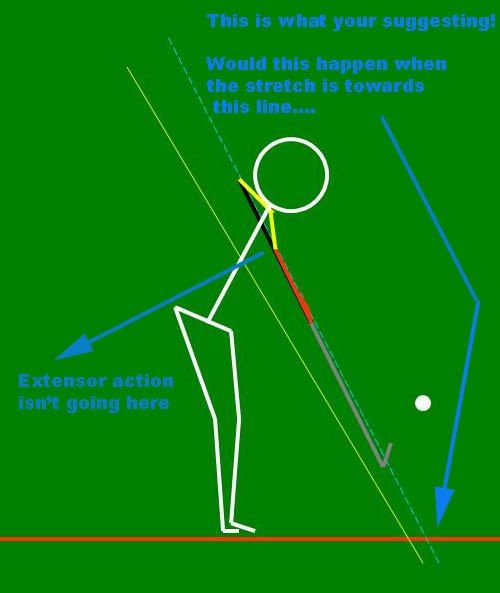
Nope, extensor action causes the shoulder flexability to be stretched towards the plane line. Thus the right shoulder is not somehow being stretched backwards towards the inclined plane that it is required to leave at followthrough, its being stretched towards the base of the inclined plane. So the shoulder flexability isn't an arguement. I mean just picture it in your mind what that would look like - anyone with a slight imagination can see thats not whats happening and your arguement is propesterous.

Mathew 08-26-2006 12:39 AM

Quote:

Originally Posted by ChrisNZ
BUt in the look look look picture posted above, if the shoulder s were not represented as straight, but instead as a curved or slight 'v' shape then both shoulders could be onplane. Now maybe it is not what actualy happens in the swing, but it is not a law of logic that both can't be onplane unless you assume a straight line across the shoulders.

I mean look....


Ungolf-like wouldn't you say ?

not only that, its unhuman and it ain't happening...lol

I mean really, is this what you and tongzilla recommend as the most important alignments?

:eyes: :happy3: :rolleyes: :eyes: :happy3: :rolleyes:

tongzilla 08-26-2006 07:12 AM

Try to give some good advice...and this is what I get ;(
 
Quote:

Originally Posted by tongzilla
I'll take the bait for the first part of your question.
  • Flat Left Wrist from Start Up to Follow Through
  • Right Forearm and Clubshaft Tracing the Straight Plane Line during Release
  • The perpendicular relationship of the Flying Wedges: the Flat Left Wrist and Level Right Wrist
  • An "On Plane" Right Shoulder from Start Down to Follow Through to give the right amount of Axis Tilt and Hip Slide
  • All Pivot Components moving parallel to your selected Delivery Line (usually the Plane Line) at Start Down
  • A fixed Pivot Center
  • A 10-2-B Grip with no wobble in Clubshaft attachment during the entire motion

I stand by my post. Lekommend asked what the most important alignments are in a Golf Stroke, and I gave it a shot. I don't understand why people try so hard to discredit what I say. I think the advice I gave is good advice, so why try to make it sound so bad? I said "On Plane", not On Plane (and no, I didn't just edit it), because I realised at the time of writing that you don't have to use the Turned Shoulder Plane at Impact. Look at 10-13-D #3, the photo with the caption, "End of Follow Through". What do you guys think that arrow in the photo is pointing at? Yes, that's right, it's pointing at the Right Shoulder socket. Oh, look, it just so happens that the tip of the arrow also points at the Inclined Plane. But it doesn't mean your Right Shoulder always has to be on the same Plane as the Clubshaft at Follow Through (or even Impact). Just look at the down-the-line angle of Lee Trevino at Impact (12 PIECE BUCKET, need your here. Please post that photo (or the whole sequence) here for our reference. Thanks!). He clearly uses the Elbow Plane, and note how far "above plane" his Right Shoulder is. But the important thing is that his Right Shoulder isn't coming from the outside -- it's still going Down and Out relative to the Plane Line (which is Open in that sequence). He's even hitting a classic "Trevino Fade" there.

So that's that. I really don't have the time nor inclination to argue any more about this point.

spike 08-26-2006 08:44 AM

I may be missing the point but it looks like both shoulders of the stickman (in both examples) are on plane through to the end of impact. Seems ideal to me.

Mathew 08-26-2006 01:57 PM

Quote:

Originally Posted by spike
I may be missing the point but it looks like both shoulders of the stickman (in both examples) are on plane through to the end of impact. Seems ideal to me.

The left shoulder is not onplane for the entire downstroke till the point of where the left arm is inline and the left wrist assumes its uncocked state at followthrough which is by definition both arms straight. The right shoulder is onplane to just before impact where it then must depart the inclined plane.

Both shoulders are definately not onplane...at any point of the golf stroke...

spike 08-26-2006 10:08 PM

Quote:

Originally Posted by Mathew
The left shoulder is not onplane for the entire downstroke till the point of where the left arm is inline and the left wrist assumes its uncocked state at followthrough which is by definition both arms straight. The right shoulder is onplane to just before impact where it then must depart the inclined plane.

Both shoulders are definately not onplane...at any point of the golf stroke...

Got cha.:redface: I'm sorry Matthew I really didn't say what I meant in that post. I meant to say that the left and right shoulders look as if they are on the same plane at impact.

Thanks

ChrisNZ 08-27-2006 02:36 AM

Quote:

Originally Posted by Mathew
I mean look....


Ungolf-like wouldn't you say ?

not only that, its unhuman and it ain't happening...lol

I mean really, is this what you and tongzilla recommend as the most important alignments?

:eyes: :happy3: :rolleyes: :eyes: :happy3: :rolleyes:

Cool pic Mathew, and exactly what I'm suggesting, although I'm not really bringing extensor action into it. Basically I think it is not ungolflike nor unhuman. To align your shoulders with your spine (which is pretty near the back of your torso, I actually think you probably need to make an effort to pull them back a bit, which is ungolflike). But we can agree to disagree if you like. I don't feel massively strongly about this, but I don't think you've provided a 'logical proof' that both shoulders cannot be onplane in the golf stroke!

Maybe from your pic you think I'm suggesting a backward curve of the shoulders, but I'm not, I'm suggesting a forward curve (that was what I saw in your diagram by the way - sometimes hard to tell with stick figures!)

And stop picking on Tongzilla! His list was really good!:)

Chris

Mathew 08-27-2006 04:08 AM

Banging my head against the proverbial brick wall...
 
I crushed the idea of an onplane shoulder at followthrough and you both know it.... yet find yourselves unable to admit it. Of course both of you would let hell freeze over before that would happen. But your arguements are absolutely pathetically absurd!

Now your plan is to make Tongzilla, the bully act the victim. It kinda like the kid that beats up on other kids and eventually goes against one that beats his brains out and then wants sympathy.

ChrisNZ 08-27-2006 04:22 AM

Quote:

Originally Posted by Mathew
I crushed the idea of an onplane shoulder at followthrough and you both know it.... yet find yourselves unable to admit it. Of course both of you would let hell freeze over before that would happen. But your arguements are absolutely pathetically absurd!

I think you should add a MWWWWHAA-HA-HA-HA to this for effect!

yours in crushed-ness,
Chris

Mathew 08-27-2006 04:49 AM

Quote:

Originally Posted by ChrisNZ
I think you should add a MWWWWHAA-HA-HA-HA to this for effect!

yours in crushed-ness,
Chris


How about


booyakasha

Would that satisfy ?

Mathew 08-27-2006 04:59 AM

Quote:

Originally Posted by spike
Got cha.:redface: I'm sorry Matthew I really didn't say what I meant in that post. I meant to say that the left and right shoulders look as if they are on the same plane at impact.

Thanks

Thats cool :)

If you observe Hunters stickman drawing at low point here - you can see that they are on a parallel angle as the plane yet still above the plane. This parallel above the plane is a reasonable approximation at this point for the dimensions of this stickman diagram (and in real life the center I think would be further above plane).. because the right shoulder and the left are in the transition of swapping over as to say...

Note that again the shoulder flexability will be stretched by extensor action towards the plane line - and not being stretched directly backwards. As an analogy, if those shoulders where a bow and the arms the string - the shoulders would not be pulled backwards (or forwards :rolleyes: ...lol) so that they would touch the inclined plane....


spike 08-27-2006 06:00 AM

Quote:

Originally Posted by Mathew
Thats cool :)

If you observe Hunters stickman drawing at low point here - you can see that they are on a parallel angle as the plane yet still above the plane. This parallel above the plane is a reasonable approximation at this point for the dimensions of this stickman diagram.... because the right shoulder and the left are in the transition of swapping over as to say...

Note that again the shoulder flexability will be stretched by extensor action towards the plane line - and not being stretched directly backwards. As an analogy, if those shoulders where a bow and the arms the string - the shoulders would not be pulled backwards so that they would touch the inclined plane....


Pretty awesome,dude..clearing it up! thanks.

Just a quickie. How would a really good horizontal hinge action effect the shoulders after this paralell to the plane moment?

Mathew 08-27-2006 06:14 AM

Quote:

Originally Posted by spike
Pretty awesome,dude..clearing it up! thanks.

Just a quickie. How would a really good horizontal hinge action effect the shoulders after this paralell to the plane moment?

No problem :)

Hinge action is something completely seperate.

Ask the same questions. Does hinge action stop the left arm becoming inline at followthrough... it doesn't. Does hinge action stop the pivot center from being above the plane... it doesn't. Does hinge action stop extensor action pulling the shoulder flexability towards the plane line...it doesn't...

So regardless what Hinge action you employ it makes no difference to the fact that the left shoulder is onplane at followthrough and not the right shoulder.

lekommend 08-27-2006 07:36 AM

Quote:

Originally Posted by 12 piece bucket
What is an uncompensated swing?

Quote:

Originally Posted by EdZ
An uncompensated swing - The most efficient application of force, based on the laws of physics, geometry and anatomy.

Thank you EdZ for the good answer.

An uncompensated swing - Smack a ball without quitting, lunging, jerking, steering, hacking and feeling bad.


All times are GMT -4. The time now is 05:23 PM.