
|
Quote:
Maxwell Smart: If I were Control, you'd already be dead. Siegfried: If you were Control, you'd already be dead. Maxwell Smart: Neither of us is dead, so I am obviously not from Control. Shtarker: That actually makes sense. Merry Christmas O.B. Left |
Quote:
All the best of the season to you and yours double D. |
2 Attachment(s)
Lets hit a shot with this guy in a circle model below. But foyst another book quote:
Quote:
Here's a great drawing followed by one that sucks. But it attempts to illustrate why when a player puts the ball back in his stance (say to hit it low ) and squares the face to the Impact Plane Line (or if you prefer "and keeps the face to his target line " in common speak) he should expect a draw shot tendency. Due to a divergence between face angle and clubhead path . Speaking of which I misspelled tendency in that drawing. BTW this is also how I personally hit a draw shot ... ball back a tad, plane line pointed right of the green or target . HOW BOUT YOU GUYS ? THERE ARE OTHER WAYS . Attachment 2939 Attachment 2938 This squaring of the clubface is Grip Rotation. One face angle of it anyways. Notice how this procedure tends to deloft the club face somewhat. And speaking of which should we mark up 6-H-0 to read" Hitters and manipulated Hands Swingers" ? How about adding "True " before Swingers? "Associate the following with True Swinging". I think so but thats just me. What do you guys think? Loft angle/ plane angle , clubhead speed etc etc will affect the amount of curvature to be expected of course ..... this model is still very simplistic. Straight away initial flight is questionable but close enough for practical purposes perhaps. We need to talk about all this stuff and more. The model only shows a circular orbit , a fixed face angle and Angled Hinging. But hey that thing can hit a draw. Or a fade . Nobody should attempt a straight shot not even a model! This guy can rotate his plane line too. |
Quote:
HB |
Merry Christmas to all who sail upon the good ship LBG.
Lynn and all thank you for another great year! |
Ok take that last drawing ball back in the stance along the Arc or Approach but instead instead of employing Grip Rotation you set the face square to the Arc of Approach at Fix. IMO you'd get a straight shot logically wouldn't you? There being no divergence between face and path . A straight shot that is pushed to the right of the Plane Line. You could Rotate the Plane Line to point this push shot at the hole however.
The face angle would be more lofted though wouldnt it? So Im thinking slightly higher, push shot ? Does this make sense geometrically? Your Plane LIne is open , pointed to the left , but there's no divergence between face and path, face is lofted a tad, straight shot resulting for a ball placed back of low point. Still talking about the geometric model here. |
Playing a slice by moving the ball forward of Low Point presents a problem in that the club will hit the ground prior to hitting the ball ....... unless the ball sits higher than ground level . LIke on a tee . This is a fairly common thing actually . Especially for guys wanting a high , low spinning tee ball . You set the ball forward in the stance , ahead of low point, you square the face to the plane line /target line (some drivers are made to sit like this these days) and swing away. But encounter a fade tendency due to the divergence in face and path . The clubhead post low point is moving UP , IN and Forward after all.
My Titleist D3 which i love seems designed to set up like this. For balls played at low point the face opens and it does seem to have a slight push/ fade tendency. I just go with it for the most part. But can add more out to the path when I need it. To hit a slice with an iron played off the ground you create the divergence between face and path required by pointing the Impact plane line sufficiently left . Plane Line Rotation. |
Quote:
hb |
1 Attachment(s)
Quote:
Attachment 2940 I guess this particular geometry (which doesnt show Hook Face) would not see the clubs loft increased vis a vis the same club positioned at low point. Its opened but not lofted. The previous drawing which shows Grip Rotation would see some hooding/delofting though IMO. Do you still see it as a low push Hungry Bear? Maybe its time to skip over to the more human side of things....and look at Hook Face , Straight Away position etc. |
Quote:
hb |
O.B.
What point are you trying to make these last 4 posts? Are you trying to show that a ball played in the middle of your stance can't be hit straight? |
Expanding the Circle
I would like to see this subject expanded to include both arms:
Don't we require a "new" center- I suggest the "head" or center of the shoulder turn (spine)? The shoulder motion supports the hands? The "on-plane" rffw puts the right elbow on-plane- where is the center for on-plane right elbow? Spine? So many golfers stop the elbow- not the pro's? What is the "real" downstroke shoulder plane? [It may not be what you think- review axis tilt effect] What is the best "feel" for the right forearm as it is EITHER driven or thrown into impact. Merry christmas HB |
Quote:
No. Is there a problem with any of those drawings to your mind? If so change them. We're in the Lab . Lets experiment, theorize , deduce, extrapolate , make mistakes and mix up some home made cocktails in beakers. Divergence between path and face angle produces curved ball flight. Steeper plane angles have less divergence . Less OUT , more Down. Lofted clubs have steeper lie angles , steeper assosciated plane angles. It seems to me that the model , (the stickman in the hoola hoop , with a club with no hook face ) could hit a straight shot (at the target) from back of low point with a square plane line but only with Grip Rotation and a lofted club .... the loft , the steeper plane angle/lie angle of the shorter stick taking out enough of the OUT in its three dimensional clubhead orbit to prevent curve spin .. prevent tilting the axis of the backspin enough for curve . And yes that is a run on sentence. Flatter planes , less lofted clubs however would see a draw spin tendency as the ball moves back in the stance though, no? |
1 Attachment(s)
Quote:
Ive created a pictorial version of the centre question ... using who else but Ben Hogan. He can be used to support almost any theory Ive noticed. Attachment 2941 |
What the heck is Hook Face ? There's more to this than first meets the eye I believe. Two correct answers perhaps. Multiple answers perhaps . Anybody got some yoda posts on the matter? Mike O made some good observations recently on the matter. Can we try to simplify or would that be wrong? Can it be drawn? Might take two drawings one for each concept ?
What the heck is the Straight Away position? |
Quote:
HB ?? |
Quote:
Version 1 the more static consideration if you will. -Its progressive as the clubs get shorter of course. -its designed into clubs by the manufacturer and yet oddly its never mentioned. -It moves the ball back of low point progressively. Note that ball placement as being related to the left foot is less relevant to the geometry . Note that it is possible to move the ball back vis a vis low point and by narrowing the stance maintain a prescribed ball to left foot relationship. This ball left foot constant is often written about , but seldom actually adhered to by pros. Their logic isnt as good as their instincts which interact with the physics of the matter . PHysics being inalterable . Its not golf physics its just physics. -each club will now have a unique place where its sits square in its impact fix alignment (which includes a prescribed amount of shaft lean) vis a vis low point. There are differences amongst manufacturers . Trial and error is the only way of identifying the correct placement vis a vis low point. This is the Straightaway Position. Why do they design clubs this way? 1. Shorter lever lengths switch ends easier, get to their impact fix alignment quicker, easier. Designing the club to sit square in an aft of low point position gives the shorter , faster levers less time ... its offsets the need for the golfer to swing each club differently given this lever length consideration. 2. Also there are benefits to an increased angle of attack on the ball . Hitting down on a ball is easier than the clean pick off which has less margin for error. A ball place back in the stance is a luxury that only the more lofted clubs can afford ... a hooded one iron played back in the stance would not loft the ball very high. And so one irons had little if any hook face as they were played up in the stance and swept off the turf. 3. I dunno. Version 2. The dynamic consideration . We need Mike O here. Version 1 and 2 are mentioned by Homer IMO. The amount of mass underneath the sweetspot on the face ..... the pie shaped section on a wedge say that is formed by the leading edge and a horizontal line running through the sweetspot.... given the tendency of the sweetspot to align to the number three pressure point implies a slightly closed club face at impact . A more dynamic form of hook face. I might have screwed this last one up or done it a major disservice. When I get home Ill research it some more. |
??
Quote:
HB |
Quote:
This is important. Hook Face is built into the design of all golf clubs. Neutral Hookface describes the Standards of the Golf Club. When Aligned to its Lie Angle, Shaft in a Vertical Plane and leading Edge Square to the Target line, a Ball will rebound along the Target Line. And, the Face will predictably Close at a specific ratio. That's the simple part. It's the Alignment relationship between the Longitudinal COG of the Club and the Clubface Alignment. The Club-maker sets Hook-Face at Neutral at Low Point. What does Hookface Do? It determines how fast the Toe overtakes the Heel of the Club. The shorter the club, the more vertical the Plane, the more vertical plane, the Faster the Rotation. This is the Heart of the Right Forearm Angle of Approach. How does it do that? Get a "Pitching Wedge." Square the Club at Low Point, then Raise the Handle up about 20 degrees and move closer to the ball. Notice that the Clubface is now aligned to the right of the target but the leading edge remained Square. Rotate the grip Counterclockwise until the face is square to the Target (don't care about the leading Edge). We already know that the Toe and Heel rotate around the COG of the Club but NOW it will do so faster and require less motion than when the club was at its neutral Hookface Alignment. YOU changed the geometry of the golf club to one with a faster closing Clubface.............Play the Ball from Low-Point with all this added Hookface and you'll Hook the Ball off the Planet because the Clubface will have way too much rotation for that Impact Interval Length! But, play the ball 6" back and the widened Angle of Approach is just right for that amount of rotation. We're taking the difference between 1/2 vs. 3/4 degree. 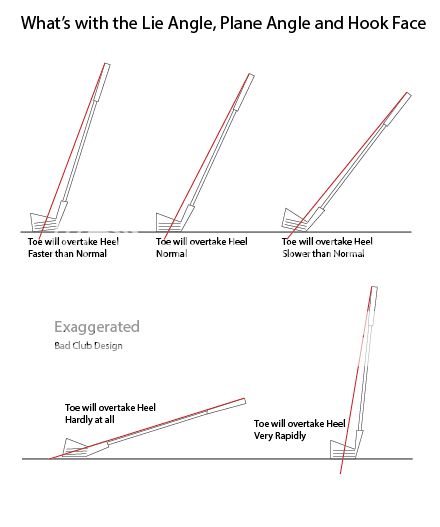 What's the big deal? Because when we play the ball back, and steepen the Plane (Geometry of the Circle), Hinge Action can Sustain the Line of Compression from Impact to Separation. Ya, we can hit a straight shot when playing the ball back 6".
So, this is a lesson in TGM. Using the Right Forearm Angle of Approach, Geometry of the Circle, Taking advantage of a Golf Clubs inherent Hook Face design, so that Hinge Action can sustain the Line of Compression. "The Hinge Action of an Angular Motion on an Inclined Plane". :think: It kinda takes on added meaning? Last Thing Moving the Ball Back along the Plane Line and adding Hookface is a waste of time unless all you want to do is add divergence. It will do that well too. Creating divergence by moving the ball away from the Clubhead Orbit, then mis-align the Clubface to compensate then spend a year in therapy/Rehab with "Mike O". |
Quote:
HB |
Here's a couple of quotes from the book :
Quote:
Quote:
I know Ive read about hook face in other contexts ( a more "dynamic " version if you will ) somewhere in the darn book .... cant find it right now.. Has anyone got em handy? |
Quote:
Right field is a tangent at impact. That is just this bears understanding. But U should pick the understanding U like. Merry Christmas :xmas-smiley-022: The HB HB |
Quote:
I get you. So to talk geometry for a moment (cause Im too lazy to draw it) the club without hook face for balls played back of low point (given no grip rotation) will hit straight shots but pushed to the right . No divergence between face and path. However a similarly positioned ball with a hooked face club hits a ball that has an initial line of flight which is a cord to the circle . Along the Impact Plane Line if the face is so aligned. But the clubhead does not travel along this plane line it travels the circular orbit and continues down and out to low point. Which to me implies a divergence between and path .... albeit lessened by steeper plane angles... ah crap I guess I should draw this.... The steepness of the plane angle and the added loft of the most hooked face clubs could negate draw spin. But there's more to the story if Homer thought that balls played forward of the Straight Away position had a fade tendency. And therein lies the point I wish Lynn or Ted or the ghost of Homer would clarify Or perhaps I have things all askew.. ? It wouldnt be the first time , nor the last. Maybe I should research the audio tapes. We need to define the Straight Away Position . |
2 Attachment(s)
Following are two attempts to draw hook-face . Well as I understand it anyways anyways. Currently. Clarification is welcome .
The first one addressing the notion of hook-face as an angle between face and shaft that allows shorter clubs to be played back in the stance with a face that points down the impact plane line. Clubs are manufactured to sit like this , easily , naturally. The second trying to and probably failing to illustrate a more "dynamic" version if you will. Just made that term up myself. A hooked-face induced by moving the sweetspot aft of the leading edge . Still trying to find where Homer alludes to this . I know its there somewhere. (HB I know you have issues with the second drawing... In regard to its practicality given theres a human holding the club etc. Just saying/drawing ) Attachment 2942 NOTE THE FOLLOWING DRAWING IS NOT GEOMETRY OF THE CIRCLE IN NATURE . MORE PHYSICS RELATED. Attachment 2943 |
Quote:
No No, If the ball es struck at the point for streight fleight then the ball will have a fade tendency even if it is still before low point. So HK is correct- (I don't have to say that)forward of the STRAIGHT AWAY POSITION is the key wording. First thing is to know if ypu are a true swinger or "otherwise" because the ball goes otherwise if you hit it otherwise.. HB |
Deep thoughts coming:
Is hook-face a built in Grip Rotation so to speak? If there is a dynamic hook-face would true swingers be able to play the ball back in their stance accordingly. Seems like they could ... if they really exist that is in the wild as opposed to a theoretical construct. The extreme end of the manipulated / unmanipulated spectrum . Those for whom CF alone squares the clubface . Ive stepped in two cow pie's in a single step here maybe. Its a good thing we're in the Lab. |
Quote:
Merry Christmas to all who may be laying around reading LBG at this moment. If so its very much a "lunatics have taken over the asylum" kind of thing this thread is. Regular programming will commence again once the guards get us locked up properly and sedated. Uh still struggling with this one HB. Can it be drawn? Where's the plane line pointing , wheres the Straight Away Position on the arc of approach etc etc ? |
Quote:
You aint gona slip thjat "CONE" by me. HB |
Quote:
Now, in the defence of cones... A swinging door (single Horizontal) could putt a very nice ball , ball location needing to be precise as it influences the direction directly . Variation in direction along a horizontal plane. Whereas a swinging pet door would have more margin for ball positioning as its variation is along a vertical plane ... blah blah blah bl.... :) (Getting back to geometry nicely. One step into the physics and yikes.) |
Here's the section of the book I was trying to find .. Hook face in a more dynamic manner , if you will. Found it in Aiming Point Procedure.
The hook-face and aiming point do relate as changes in ball position away from the Straight Away Position can / must be offset by changes in the Aiming Point Procedure . Most commonly done subconsciously . "Done by feel" in common speak . Hand / eye. IMO. You get a feel for the stick in your hands , how it "swings" with a practice swing or waggle and then hit the ball having made a suitable adjustment to the feel / effort needed to make that particular lever switch ends and arrive at its Fix alignment at Impact. In one sense, the Aiming point as a spot along the Arc of Approach is a way of tricking yourself into making the club release in a speedier , slower manner so as to reach its Fix Alignment more correctly. Done via trial and error . IMO. Leaving your driver out to the right ? You could move the Aiming Point ever so slightly back along the arc of approach to trick you into applying the force necessary to square the club quicker.. so to speak. There are other applications too , concepts relating to Aiming Point. This aint geometry of the circle either but we're gonna need it to understand the Homerian view of the manner in which a golfing master hits the golf ball. Uh if that's possible .. tbd. gonna need a little help from our friends. FROM THE 6TH EDITION. Quote:
|
Quote:
HB |
1 Attachment(s)
I dont know about an update , but I can do down date. Er back date.
Here's Abe Mitchell , from Down To Scratch , 1933. Attachment 2944 Sounds like the Aiming Point Procedure to me. I'm thinking Homer might have read this book , maybe. Who knows? Abe touches on what Homer calls Hands to Pivot as well, IMO. Perhaps the above was a procedure Abe discovered on his own through years of trial and error, or perhaps some other golfer gave him the procedure? Itd be an interesting thing to ask a golf historian. But the physics behind it, the reason to do it I believe is what Homer was referring to in 6-E-2 when he said; Quote:
Now alternatively or additionally IMO, you could of course CONSCIOUSLY change your Release Point ..... Release a tad earlier for the longer , slower to switch ends clubs. This is one reason why getting so nutso about Snap Release , beautiful though it is , can cause some grief IMO. Snap , Random Sweep , Full Sweep Release are necessary adjustments available to the master golfer. The physics , the reason for their employment though largely unknown to the golfer is still there. " You gotta sweep your long irons" was a common phrase back in the days of the long irons. Accomplished via ball position and release point considerations in TGM terms. Or you could just "get a feel for it" by watching others, "brush the grass". There's a sound to it too , not much divot if any etc etc. Wanna hit your 7 iron a little higher than normal to get over a tree? Move the ball up in the stance , employ a slightly earlier Release Point or move your Aiming Point or various combinations there of. Or in common speak "sweep the ball off a forward ball positioned forward in your stance". |
Quote:
Well! After rereading 6-E-2 slowly about 50 times word by word and your comments above I have come to a conclusion. AIMING POINT IS A RESULT of alignments NOT AN ALIGNMENT BY ITSELF. After getting alignments to a point of satisfaction the aiming point becomes a "marker". As U said in the 7 iron paragraph HK said in 1,2,3 page 83 ( 6th edition) That is why I have a 68* wedge and a #1 iron, for practice only, never in the bag but practice smooth release, ball position and keeping hand rhythm THROUGH impact. You mention snap release- The cure for the "snap release" ambition is to know that the entire right forearm goes into impact and maintaining right wrist bend. U can't "flip" that assembly. HB |
Re Aiming Point (PROCEDURE-- the looking at a spot on the Arc of Approach version, not the often subconscious help the longer levers switch ends version, or any other version . Dang theres others too! ) as an Alignment : thats an interesting question , comment. If each of our own individual Aiming Points are somewhat unique and found through trial and error then perhaps its not an alignment. More like a trick to override the physics , the COAM or is it the MOI or the CiA? FBI? I'll leave physics to those that can understand it better than I do which is just about zero.
So you got the geometry (of the circular clubhead orbit etc ) , you got the physics and you have the necessary mechanical alignments (which all relate to impact alignments). The right forearm flying wedge is for sure a mechanical , structural Alignment of the first order. Up there with the Primary Lever. Get those two working and you're on your way. In terms of the geometry ..... Homer's was not the geometry of equations , more the geometry that could have been drawn. I'd like to see an effort to draw as much of it as we can. Draw the circles , or a portion there of (arcs), tangents, cords, angles . As seen from different perspectives . The very same entity can have a different name when seen from a different perspective. Unless you can see it IMO in drawing form , communication via words is challenged. Perhaps some of the physics could have an associated drawing , of a model or something. Words only go so far for me on that front as well. But that would be worthy of another separate thread. If you start one I'd be happy try to draw a few things floating around in my visual memory banks. Id have to leave the heavy lifting to you and others who more in the know ..... Or perhaps it would be too much of a simplification ? |
Quote:
Am I pulling this thread away from the circle- sorry. HB |
No the master golfer can manipulate the geometry or the physics to suit his needs. Some alignments may change as well. Ernie breaks his flat left wrist to intentionally top a skulled wedge for instance.
This is whered I like to be able to get with this thread. A place where we can discuss shot making procedures using a common vocabulary ..... Let's use Homers terms definitions. Let's try to clear up the broken telephone to the extent possible. Maybe it's impossible. Maybe Ive already muddled up too much stuff. Maybe I've already taken a wrong road and should stop. I dunno. Also , more importantly I hope I haven't lost anyone who may have a different point of view as I try to push things forward. We can go bqck at any time Consider everything a wiki . Id like to get us to an old post I want to discuss and to discuss some more geometry perhaps .... Angle of approach.... Homer at his most obtuse. Its a geometric thing IMO. It can be drawn. What if we could discuss how better golfers hit certain shots, procedurely .... and not get bogged down in the differences we all have in the interpretation of terms. On my iPhone sorry for any typos |
1 Attachment(s)
I received an email saying that the model as presented would take a divot that was equal lengths on both sides of low point!!!!! Which is correct!!!!!
Then the question was why doesnt that happen to the guy on the course. And doesnt this throw the whole notion of low point as being opposite the left shoulder out the window? Short answer is no, IMO. That little hoola hoop with a radius that hits a golf ball is a big simplification fer sure but it can despite its limitations produce some interesting clubhead paths , more real world than what you might think at first glance. Despite its single levered , flat as a pancake 2D , fixed radius length, ways. Here's what Im thinking guys please correct me where you see fit. K while so while sticking to a one lever model we have seen how when the circle shifts planes , up and down the club heads path takes on a more 3 dimensional nature when viewed from behind , down the line. Dang... those words make it all sound so complicated . Lemme re phrase. If you shift the plane of the circle the actual path of the clubhead looks very unplane like when viewed from the down the line.... with a multitude of possible curved paths. Ah heck maybe I have to draw this better with some actual tracer lines of clubheads etc . So... we saw what happened with shifting planes and shifting planes do happen. Lets take a look at what things look like when the circles centre moves . And that happens in real life too, IMO. For more relevance lets move it in its own circle which has its own centre . Namely lets move the left shoulder , the centre of the Arm Swing as HOmer called it, about the centre of the pivot located at "a place between the shoulders". Not the head , the head being less correct but making for an easier visual reference point , if you will. Enter a second lever if but momentarily ... Heck just look at the drawing. Attachment 2945 Should the centre of the circle (the left shoulder ) move up (as it would through an actual players impact area) the low point of the clubheads actual path moves "back in the stance". Therefor the clubhead would not take an equal length divot on both sides of low point. As is the case for the human on the course. Good thing we're in the Lab. Ive got my white coat on fer sure now , heck ive got pocket protector , goggles , clip board, martini in a beaker.... slice of cucumber as a good luck charm. P.S. I should clean that drawing up a little as it looks like he's loading #4 angle through the shot rather than throwing it out. However , it makes no difference to the topic at hand IMO. Namely , low point is always at 6 o'clock but the clubheads actual low point may occur earlier in the stroke. |
2 Attachment(s)
Ah crap I was trying to stick to geometry and hit some shots with the geometry of the circle model, but since we're here ......lets talk mechanics , alignments ....maybe even centres if you want to.
K, so see how the shoulders in the drawing above move in a circular manner? If you drew a little circle with " a point between the shoulders " as the centre ... the centre of the shoulders / pivot ..... wouldnt it look like a little fly wheel? If you grabbed ahold of the right shoulder and spun it down plane wouldnt that be akin to Yoda's " spin , spin spin the flywheel"? Lemme try drawing this.... First with the geometry of the circle model , 2D then with a more human 3D stick man from the down the line. When we go 3D we'll employ Homers Turned Shoulder Plane and a Standard Shoulder Turn ..... flat back and down plane with the Right Shoulder. The Right Shoulder takes the Hands , the #3pp the club downplane in Startdown. Attachment 2946 Here's a Yoda post that touches upon this co-ordinated pivot leads the arms downplane in startdown deal. There are others. Attachment 2947 Quote:
Quote:
Quote:
|
3 Attachment(s)
Sticking with mechanics , physics for a moment (and Im way out my league here and want to get out of here asap) ;
Websters dictionary definition: Attachment 2948 A portion of Lynns post above : Attachment 2949 A photo of a flywheel : Attachment 2950 So that little wheel inside a wheel drawing.... which I theorized to look like a flyweel , needs clarification for relevance to Homers concepts about the role of the pivot in the Startdown (swingers and 4B Hitters startdown IMO, drive loading being a different deal). Namely: -the pivot is the flywheel. -the pivot is heavy. Heavier than the arms . As if the flywheel in the geometry drawing is made of heavy brass. -the pivots rotation pulls the arms in startdown , leads the hands (not the arms) down plane given that the right shoulder and the hands lie on the inclined plane together if only momentarily. Neither arm is on plane at top however. - mechanically a heavy flywheel steadies the rate of acceleration , smooths out any oscillations about the "shaft " or rotor. The pivot aka "golfs basic rotary motion". The heavy flywheel steadies the pivots rate of acceleration . - once set in motion , the hands and club become gyroscopic in nature . Spinning about the axis of rotation , the pivot centre. -gyroscopic motion when present resists plane shifts . But plane shifts are possible through manipulations in the arms relationship to the pivot.... "vertical drop" prior to spinning the flywheel. -the gyroscopic motion continues until the arms are thrown off by the slowing pivot, "momentum transfer" from the pivot to the arms. At which point the Primary Lever, the left arm and club begin to SWING about their own centre , the left shoulder, which in the both human golfer and the 2d model above is moving. -pulling by the arms from top ruins the whole thing. Aka "hitting from the top". -over acceleration of the pivot from top is defined as commencing at an RPM which cant be maintained . Over acceleration by definition implies deceleration of the pivot , pre mature deceleration , IMO. EArly throw off . Bear, anybody please clean this up..... whatcha think. Why did Homer talk of flywheels? Did it , to his mind , imply a relationship between body and arms in terms of their co-ordinated motion? Rotors and blades the rotor having a flywheel? Does this relate to his concept of Rhythm? Does this relate to "effortless power" ? IMO the flywheel conceptually implies that you : "spin , spin, spin the (heavy, smoothly accelerating, well centred) flywheel (pivot). But, I could be wrong. |
Quote:
http://www.youtube.com/watch?v=EWLt8qsxMAk |
| All times are GMT -4. The time now is 11:07 AM. |