
|
Quote:
http://www.lynnblakegolf.com/forum/post93886-4.html hb |
Quote:
 |
1 Attachment(s)
Here's something I drew a while back with another intention in mind. For this discussion (how to shape your shots) lets just acknowledge how the circle looks different from different perspectives. How the players view of the circle becomes more circular as the plane angle lowers.
Edit : And also acknowledge how the actual path of the clubhead along its circular orbit has more OUT to it for flatter plane angles. Guys feel free to correct this where it needs to be corrected. Blunders or whatever. The curves are hand drawn and need to be improved for starters. Attachment 2932 |
Quote:
|
Quote:
Er, wait ... should it read "2 dimensional inclined plane" ? My head hurts. From the 7th I believe Quote:
|
Couple of Homerian terms to go then we can hit some draw shots .
Anyone wanna tackle what Homer meant by Grip Rotation? We're gonna need it. |
Quote:
If the ball is moved back , the hitter will hood the clubface to maintain a square leading edge, a draw will result, and if the ball is moved forward the hitter will lay back the clubface to square the leading edge. and a fade i s result. rotate the grip to do this. The swinger , with horizontal hinge, when the ball moves back it opens the clubface3. Just rotate the plane line to conform to clubface alignment an fade. move ball forward, rotate the plane line to match the leading edge and a draw will result. Do not move your stance in hitting procedure. the hitter can take a normal address , move the ball back/forward then rotate their grip. The swinger can take normal stance, then open or close their stance which will have the same effect as moving the ball back/forward and will accomplish the plane line rotation at same time.The swinger does move HB |
Quote:
Isnt it more correctly Hitters and Hand Manipulated Swingers ? Meaning just about everybody except the True Swinger ... those for whom CF [U]alone[/u] squares the clubface by definition? The answer to this question doesnt matter in regard to the geometry at hand .... if when you position your ball "back in your stance" which we now see as being BACK , IN , UP (thank you D) along the golfers view of the circle , THE ARC OF APPROACH you also rotate the face square to the Target Line , Impact Plane Line you have effected GRIP ROTATION according to Homerian definition. (interject please anyone who wants to redefine). Draw shot resulting but in accordance to the amount of OUT associated with path of the clubhead ..... the distance between the IMpact Plane Line and the Low Point Plane Line on the Basic Horizontal Plane given plane angle. And loft etc. Still talking theoretically here looking at the circle diagrams. This may seem weird . What about grip spines aligned at 6:00 o'clock on the shaft wouldnt grip rotation move these spines counter clockwise in the hands ? (yes) And is a six iron really designed to be played at Low Point? Homer said no! Enter Hook Face , enter confusion and differences of opinion perhaps ... tbd. I see two schools of thought , perhaps both co existing ... Maybe we dont need to go there ? We could just stick to DIVERGENCE BETWEEN FACE ANGLE AND PATH . Thats the basic basic to common speak "side spin". Uhhh Homer never said "side spin" he referred to it as "tilted backspin" (no caps) .... the ball can only spin around one axis I believe. Closing in on draw shot tendencies for balls played back in the stance and a sketch there of from the players unique perspective and in accordance to plane angle considerations. A useful visual for the golfer in shot shape training. |
I hope that you're keeping in mind that any distance the ball is played aft of Low Point, that a corresponding steepness in Swing Plane must be applied to hit a straight shot.
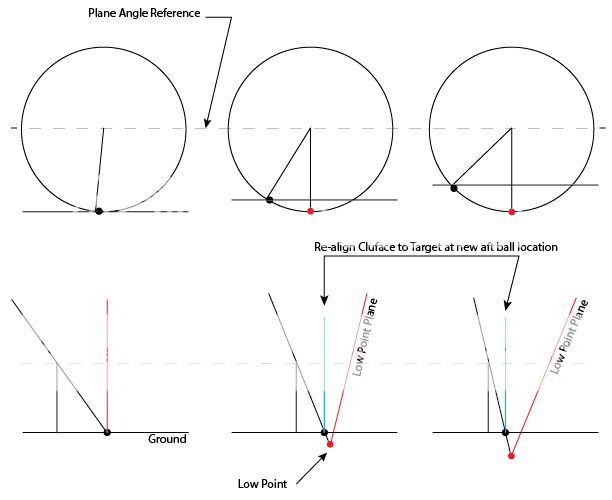 |
Quote:
|
It's what Homer Kelley is talking about.
As the Plane Angle is Steepened (as the Ball is Played back), the Clubface (because of the steeper plane) will produce a push type shot although the leading edge is square to the target. See for yourself. Do all of this at Low Point. Get a Club, square it all up, then raise the grip end but keep the leading edge square. See, the Face points to the Right. Then, re-align the Face by rotating the grip until the face will produce a re-bound down the target line. But that's the easy part to understand. What we want to know, is how can Hinge Action sustain the line of compression so the ball will fly straight. For that we need to learn how the Right Forearm Angle of Approach, when applied to a steeper Plane Angle, will increase the closing ratio of the clubface.
It's really, simple. This is a big part of Chapter 2. |
Ok teach, simple?
Quote:
So with a normal width stance, and the ball played at my belt buckle, I decide to hit a 9 iron and aim 2 inches in front of the ball with Aim Point Technique to hit a shot straight to the pin. Normally, that's what will happen. I did it yesterday with all sorts of clubs. :whistle: LOL! But let's say it's windy so I want to slide the ball back in my stance. Does the ball move closer to me? Do I hood or close the club face? Am I possibly the slowest golfer on the planet and in need of a new hobby? &D: :clown: ICT |
Quote:
If you move the ball back, then you must include a corresponding Plane Angle Increase and grip adjustment. Grip Adjustment is for Face and target line, and Plane Angle increase is so that Hinge Action can produce a straight Shot but also that Low Point isn't moved from below the Hinge Pin. |
First, I'm not jacking this thread.
Quote:
Quote:
Quote:
Quote:
Quote:
Quote:
Steepening the Plane offers faster Clubface Closing for shorter Impact Intervals. You must see the Right Forearm Angle of Approach, then you'll visually see this in action. Homer said (i'm going to paraphrase), that the golf club is designed for the way that "Humans" swing the club. Somewhere along the way we lost that connection. And the connection, I'm sure, is the Right Forearm Angle of Approach and the Geometry of the Circle. I Know what you're thinking, but I'm not being pig headed. |
comments
Couple of comments:
1 I do not believe the "practical range" of fore and aft ball positioning for any given club is "wide" enough to trigger these other concerns. 2. please examine Hogan's atance/ball position drawings-page 125, Five Lessons. I can't copy the drawing. Pay particular attention to: He moves the ball back for each club by narrowing his stance and opening his stance. He effectivly rotates his plane line and maintains his target line when he op-ens his stance. Sugestion - I believe HK has included this info- maybe in bits and pieces- As we find those bits and pieces we should include them here. HB |
Quote:
Did the Ball Move aft of Low-Point? Low Point is adjustable. Narrowing the stance with his method, will cause the right shoulder to move Forward. Its the Right Forearm Angle of Approach. Longer Clubs cause the Right Shoulder to be rotated more at Impact relative to shorter clubs. So, using his method, the release point and aiming point is similar for different length clubs. Notice that at Impact, shorter clubs have Right Forearms that are more Vertical. Therefore, the Right Forearm Wedge is becoming in-line at a much faster rate. Opening and closing your stance will affect Hip Action. It doesn't cause a plane line rotation unless you align your shoulders to your stance after the change. Notice that Hogan used a Closed Stance while Driving but his shoulders and Swing remained squarish to the Target. |
Hey we got 55 posts in before needing to stop to clarify something... not bad. I hope we didnt lose BerntR gonna need him and HB , I know we set aside issues they have with the centres . We can come back to it though with drawings that address that specific issue. Its just not necessary to clarify that issue IMO to discuss the implications of the Geometry of the Circles orbit to ball response given plane and ball location, face angle , hinge action changes. Suffice it to say there is a constant centre and a straight Radius and therefor a circular orbit. Unhuman though this might be... It was a model a mode of examination that Homer had available to him at his time of writing . Much can be deduced from it.
D, that wasnt a jack. Do you want to pause to discuss your post #49 more or just leave it for now? I see some need for friendly debate / discussion coming on some concepts very central to shot shaping. Bear we're heading towards Hogans stance / ball diagram from Five Lessons dont you worry. But we need to draw as much of the geometry as is possible first , so we're speaking the same language . It gets a little ..... deep in a Homerian way. We might need audio tape transcriptions from the GSEM classes for clarification. Even then it might not come clear. TBD. |
Digging the positive vibe teach!
Quote:
The ball is about an inch closer to me traveling along the 2 dimensional Plane, and my club face is closed about 2 or 3 degrees. Would't I wind up hooking the ball off the planet given a straight away target line and square/open left set-up given a standard Aim Point? Or, have I not grasped something obvious which is probable? :scratch: ICT |
Is it not right to discuss Aim Point here?
Quote:
This is interesting and important stuff. ICT |
Quote:
Another way of thinking of the very common wedge shot , chip shot stance : Stance line open, hips open , weight left , hands ahead .........Its an impact fix /address. You have minimized moving parts, weight shifts for simplicity , consistency . The Plane Line could still point anywhere. A quarterback can be running left and throw to his right! The stance line here is not an indicator of plane line. Sorta like how the common putter grip runs through the palm of the left hand and thereby zeroes #3 angle , the travel associated with all hinge actions thereby taking on the travel associated with Vertical Hinging , zereoing #3 power accumulator etc. It deadens the send to the ball somewhat making distance regulation easier. Normally the putter is the shortest lever in the bag too. For a reason. The physics of it is lost on us golfers but through a collective trial and error process, if you will, we land on things that are adopted by most. They become standards without us knowing the reasoning, the physics behind it. And of course you do always have exceptions, modifications etc. Guys who do other things with great results ... but always with the physics of their procedures showing itself .... But I digress.... |
The "problem" .
I have to go fast to catch up to you guys ... want to nail the book quotes, support it with drawings.... leave no room for broken telephone ..
Quote:
Need a drawing from the players perspective of the circular orbit while the clubhead is say two feet away from the ball along the arc of approach with the face sqaure to the arc (lets assume angled hinging for now) and another a second face covering the target line (and it will appear to be directly over the plane line given the golfers perspective while it isnt so when viewed from a DTL perspective) and lets square this second face to the plane line. The arc of approach will appear curved to a degree in accordance to the plane angle what do we want elbow ... lets make it a lower one to accentuate the curved nature of the arc for illustrative purposes .... not to scale . Scale makes all this stuff look insignificant interestingly.... when it isnt , not at all. Note how the Steered face is taking a higher plane angle , nearly vertical when viewed DTL , not quite vertical as its planed though the golfers eyes. Remember extension , low to the ground , square to square . Thats the triad of Steering . Quote:
|
How much movement of the ball back of low point can there be before these "problems" occur? Too much, and the player will mentally move the low point back and wreck their Impact Alignments. &B:
There's a reason why some the best players in history played the ball in one location. |
Quote:
I wonder if players who widen their Stance like Hogan use one Ball Location more than players who maintain a certain stance width for all clubs? |
Quote:
I was thinking level lies and moving the ball back for trajectory control. |
K the geometry of the circle so far assumes a flat lie.
MJ re guys we love who wrote books and said they played the ball in the "same place" was t it vis a vis the left foot? If so and if they also narrowed their stance progressively consider how the left shoulder moves vis a vis the left foot. A wide stance versus a narrow stance. You could consider that if they did actually imploy a constant ball position vis a vis the left foot ( which is debatable) they had effectively moved the ball back of low point with their narrower stance. I'm writing on my iPhone my apologies if I'm not clear |
Quote:
|
Hogan kept his head a few inches behind the ball with a wood in his hands and practically straight above the ball with a wedge.
... and narrower stance and more weight over the left hip at address towards shorter clubs .... and less secondary axis tilt towards impact towards shorter clubs. More on top of the ball, less behind. |
Quote:
K I got to back .... dont want to leave anything behind when possible. MJ I know you know this stuff but for the benefit of others, the "problem" as Lynn refers to it in his power point presentation to his certified instructors (i believe) is Steering the attempt to steer the clubhead straght line away or towards the ball with the face square to the ball. Add an attempt to keep the clubhead "low to the ground" and you have all three forms of Steering. The "problem" is perceptual , in our dismay we start to think about solutions to this crazy arse game and we land on a the more familiar to us linear approach . Like pool or whatever. We try to achieve , to the extent we actually can, a linear Delivery Path of the Clubhead with a square face (Vertical Hinging) Ill try and draw all this. ........... Major aside here... this geometry to the extent it can actually be manipulated has an effect of the ball response. The physics of it can not be denied. Usually its a terrible set of impact dynamics for a tee shot (watch any hackers lame duck tee ball, leaving cross line slice aside for now). But useful for certain shots perhaps (the same hacker might have a decent high soft wedge shot if he grooves it). His straight back , straight through putting may be quite good actually. Daryl do you have drawing number 2-C-3 #3 Linear Force -The Lob Shot on hand? if so can you post it upside down from the player perspective. |
2-c-3 #3. Ok I'll post it tonight. It's not with me.
Dual Vertical Hinging requires that the Clubhead follows the Orbit no differently than other Hinge Actions with the exception that the Clubface is aligned to the Vertical Plane. Why Steer? Because people don't believe that you can strike a ball with an angular force yet make the ball respond as though it were struck with a linear force. Not having done so, how could they know otherwise? |
1 Attachment(s)
Attachment 2933
Heres a real rough doodle I just did of the players view of Steering (two forms of it) . Took a photo of it emailed it to myself , fixed it up a tad in Iphoto and posted it. Took about 10 minutes ... no scanner available to me right now. Guys please draw some doodles if the spirit moves you, let it groove you. We need drawings , even bad ones... like this and worse. Please correct it where you see fit. Ah crap just noticed I forgot to label the curve as the Arc Of Approach , the players unique view of the circular clubhead orbit . Also that elbow plane solid line is the straight on view of the circle ... it looks like a line ... I should have extended above his head a bit more. We're still talking about the geometry of the circle model here , stick man , 2D perfect circle , constant centre and radius etc. Like the stick man has himself in a giant hoola hoop. What circles look like from various perspectives although we added a clubface . Enter a whole bag of considerations with that one. That curved Arc of Approach is approximated. Probably exaggerated somewhat for illustrative purposes . The to scale version the actual arc might even seem trivial but it isnt! Notice also that the Steered clubhead (#1) still has some OUT to its orbit . Its not going to compress the ball very much but it does have some 3 dimensional impact to it. Not the ideal , not much but some. If the player got his eyes right over the ball things would be different just Down and Forward , no Out whatsoever. true 2D impact. Small point but since we're here. Imagine trying to articulate that in words....thats why I believe drawings are necessary when discussing geometry. |
A huge reason for this problem is that the golfer MUST realize that you are looking at the plane from above.
Your eyes make you want to have as vertical a move as possible because our mind tells us the back of the ball is the place to hit. Once you can really visualize that you are looking at a tilted roof (the plane) from above, a lot of TGM will become easier to absorb. Shot shaping then becomes a matter of moving the machine around for the shot you want. Perhaps one of those times it is good to have "your mind in the gutter" :) |
Quote:
|
Quote:
Thanks for sharing guys. Kevin |
Quote:
|
Mr Left,
Very interesting discussion in spite of the handicap you have introduced. There's something intriguing about Daryl's analysis about how straight the right forearm is, depending of the club. It has implications for impact alignment. The pivot need to be more turned through with a driver than a wedge or so it seems. The position of accumulator #1 and #4 at impact will be different for the two clubs. Basically there will be more left with a driver since the right elbow will have more bend... Not sure where this ends, but it has consequences to how low point is produced ... Everything else equal means that hands will be relatively more forward when the right elbow is straigher, thus more forward with a wedge than with a driver.... Of course to analyse these differences properly, the left shoulder can't be regarded as the swing center ;) |
Quote:
Yes the model , as ive called it (so I dont have to keep writing the geometry of the circle over and over)... is very limited when compared to the multi levered human body. There's much to consider there for sure , absolutely and how the human must interact with various clubs , lever lengths etc : MOI, Hook Face, Straight Away Position, Aiming Point Procedure, Release Point, etc etc etc . But before we get into all of this stuff let alone where the centre is , where low point is lets try to understand a more simplified model . Once understood we can tack on additional mechanics , levers , face manipulations , release manipulations , move the left shoulder as centre of the arm swing forward , out and down and then Up and In along its own path etc with implications to low point as the dirt sees it anyways. Or so I hope .. I dunno if we'll get there or not. TBD. The geometry of the model is very basic , more basic than the machine of 1-L which can double hinge etc. I have a feeling Homer examined the 2D geometry of the circle and then saw the need for the machine. If so Homer's been right where we are right now.... seeing the limitations of the basic model vs a human multi levered system. However, IMO theres much to be seen in just the simple circle laying flat to an inclined plane. Its already showing: -how the 2D circle given plane shifts can create 3 dimensional clubhead paths ... best viewed from the down the line. With no change to the plane line base line. 1-L-18. -angled hinging. -what the correct clubhead path should look like to the golfer given different plane angles. -what steering looks like to the golfer. -what the face should look like in startup to the golfer (assuming angled hinging). You need the machine of 1-L to see vertical and horizontal. How many golfers can say they know this geometry? Its not a golf thing or a Homer invention its just the geometry of it . It just is, IMO. |
Anyone want to figure out how many 1-Ls we've knocked off?
|
1 Attachment(s)
Before we hit a few shots with our model we need to see a few more things in regard to the relationship between plane angle (and lie angle) and Hinge Action.
Namely Quote:
Here's a truly awful drawing trying to show this. Using the model which can only portray Angle Hinging . The circle not drawn but it could be. With a centre shafted clubhead .... which keeps the shaft and sweetspot on the same plane for simplicity . The arc drawn is from the players view of the clubhead orbit , the Arc of Approach ... not to scale . The face stays square to the arc , angled hinging. Also defined as... the face stays perpendicular to the inclined plane. Attachment 2937 What does this mean to the human on the tee? As he or she moves to more upright lie angles (shorter clubs) the hinge action takes on the characteristics of Vertical Hinging . The clubface starts to layback more and close less . There's less clubhead travel associated with Vertical Hinging too assuming some #3 angle ( this is the human again not the model). There is more loft associated with more upright clubs. Less out to 3 dimensional impact. etc etc The ball responds accordingly. The axis the ball spins around (and it can only spin around one axis) tends to tilt less. Less "curve spin" if you will, more "back spin" . Less compression. Less ball speed speed . |
Nice post. Forgive me for trying to steer this to what I think of as "The Circle" and its Low-Point Geometry. Your post is very insightful regarding how Hinging changes as the Plane Angle changes but I think you're getting ahead of the Basic idea of the Geometry of the Circle. It's a very simple but profound subject regarding Golf Club design and an Orbiting clubhead and why we humans are so successful at hitting a ball with a club.
When I think of the Geometry of the Circle , what seems to me, its basic form, outlined below. Imagine an Orbit on a Horizontal Plane. It represents an On-Plane Force (Stick without a club-head) moving around and around while striking a ball anywhere on the orbit without having any different ball response. When a Flat Striker is introduce, the response will be the same for direction. Then, when we angle (incline) the Striker, we'll see the same response for direction because the ball will rebound at right angles to the "Force" but in addition, it will rebound at right angles to the Inclined Striker (Loft). The Loft creates a Vertical Plane to the "Horizon" (considering a Horizontal Orbit). When the Orbit is inclined (Inclined Plane), the Plane of the Loft becomes a tilted Vertical Plane (Tilted to the Horizon) but the ball response remains the same while struck at any "Point" on the orbit. The ball shoots off on a trajectory above the circle relating to how much the Orbit is Inclined and gravity pulls it downward from its Plane. When the Lofted Striker is re-oriented so that the Loft Plane is Vertical to the Horizon,it Will only be Vertical to the Horizon at one point on the Orbit. This creates what we call "Lie Angle". Although the Ball response remains the same, we have a "Point" on the Orbit, when aligned to a target, will produce the desired straight shot (given an elastic collision). HK called this, where all of these Alignments converge, "Low Point". The Striker Alignment is tangent to the circle (Horizontal, direction) and only at the bottom would it align to the Target. And, we have a Stick (Force) with a Lofted Striker, at Right Angles to the Tangent. Rightly so, we now have "Low Point" Geometry and it is at the Bottom of the Inclined Orbit. So, Geometry of the Circle, is about the Orbit, of an aligned inclined striker Force, and where on the orbit, it produces the ball response we want. So, a Low Point Impact is what will achieve our goal. Playing the Ball before Low Point Geometry is very attainable because the inclined striker and plane angle can be changed to reproduce the Straight Away Alignments of Low Point. After understanding the "Circle", we apply tools such as Hook-Face to accommodate Ball Location Changes. Hook Face is another subject. It dramatically changes Alignment and the way the Clubface closes. We should explore this along with Plane Angles and Ball Location. These are changes that accommodate Ball placement changes on the Circle. Hinge Action is method we use to control the Ball's "inelastic" collision. The Ball can respond to an angular force as though it were struck with a linear force. Hinging adjusts to the Circle as well as Hook Face. Hook-Face is the way we re-align the equipment, the Right Forearm Angle of Approach and Hinging is the way we re-Align the Machine. |
Quote:
Yes the circle model like all models is not perfect . Although the Victoria's Secret brochure just showed up in the mail.... now those models are perfect. So theres an exception to every rule, which in itself is a rule which might have an exception. But how do you know Im Control, Zigfreid? |
| All times are GMT -4. The time now is 12:15 AM. |