
|
Quote:
|
Quote:
There is a horizontal grass line in the background. Compare photos #1 and #6 and see how much his head has dropped. It's dropped even more in the Follow-through (#7). Draw a vertical line down from his left ear . The left ear is quite a bit farther from the inside left heel in #6 as compared to #1 and and even more so in #7. From this I conclude that his head is moving down and back from the Top into Impact and continues to move down and back even more from Impact to Follow-through. If you all agree that this full swing (pages 124-125) represents a Head Pivot Center, that's fine. I just see a ton of head movement there. |
Teaching the Stationary Head
Quote:
And unless the student is hanging the Head well to the right in the Stance, I leave its overall position alone. To help the student become familiar with a proper Head position, I will sometimes put him into an Impact Fix to show where the Head will be at Impact. I then recommend that it should stay as close to possible to that location. On Short Strokes, I insist on a centered Head. There is no time to be shifting about, and with the Head centered, the Left Shoulder (and hence, Low Point) will be where it needs to be for a good Hands-in-front Impact. Most students hang their Head too far back behind the Ball in the Short Strokes, and usually wind up scuffing the Ball as a result. A Centered Head and the Flat Left Wrist techniques always works its magic here. Interestingly, with TOUR players or with good amateurs who genuinely want to improve, I can be -- and often am -- more demanding. But only with video support and only after a crystal-clear discussion of what is happening in the current motion and why. Only then will I initate a discussion aimed at establishing and maintaining a Head location different from the one they are accustomed to using. As an example, the weekend of the British Open, Brian Gay and I worked real hard on first understanding, and then implementing, a more Stationary Head. This is a major change for anybody, particularly someone with habits as ingrained as those of a money-making PGA TOUR competitor. Results? Brian had a solid tournament the following week in Milwaukee and then tied for 15th (in a starting field of 156) at the next week's Buick Championship. So, at the very least, and in at least some cases, I can say that such an approach doesn't mess people up! :) |
Teaching Billy Casper
Quote:
Assume that Billy is your student and, with regards to his Pivot, wants to know, first, what he is doing now, and second, what (if anything) he should be doing to get better (and remember, these guys will kill for one-quarter of a shot per round). He also expects you to justify your recommendation. Some tough questions need to be addressed: If it is not a Head Pivot Center, then is it a Between-the-Shoulders Pivot Center? In your opinion, does he have a Pivot Center at all? If not, do you think he should? If so, which one? In other words -- seriously, Bob -- if he were your student, what would you tell him to do...and why? |
Quote:
I thought a head pivot center sequence would look like Diane in Chapter Nine [6th Edition]as seen in photos 9-2-1#1 (Preliminary Address), 9-2-2 #1 (Impact Fix), 9-2-10 #1 (Impact) and 9-2-11 #1 (Follow-through). She doesn't look like BC to me. If Casper's sequence from the Top on pages 144-145 is, in actual fact, a head pivot center sequence, then I obviously don't know what a HPC is or what it's supposed to look like. Just looking for some understanding here. |
The Compensated Head Pivot Center
Quote:
The many prior posts on this thread and on similar threads here and on Brian Manzella's site have focused on the Backstroke Pivot and its Center. Accordingly, the primary purpose of my publication of the Casper sequences was to provide an example of a Head Centered Backstroke. Hence, my directive in the introducing post to "Check out his Head Positon at the Top of each sequence." There is no question in my mind that, at least in these sequences, Billy is using such a Head Pivot Center. The intriguing question you have essentially introduced, then, is... Does he change that Head Center to a Between-the-Shoulders Center on the Downstroke? Or, has he simply failed to achieve the perfection of the original Head Center? I've already commented on the Bobbing in the Stroke. It is a common phenomenon often caused by a failure to position the Head at Address in its Impact Location (hence requiring the Bob as compensation). Regarding the backwards Sway, using that tilted, upside-down triangular shape in the background as the constant, I truly don't see the "ton" of movement you do. It is there, but photos are an exacting measure, and even the most talented among us are entitled to at least some margin of error. Homer Kelley knew that, of course, and that is why he always advised to set your Head where you want it at Impact and then do your best to maintain that location. In other words, centered between the feet (his ideal) or to the right or to the left -- wherever you put it -- leave it there, as nearly as you are humanly able to do so. Personally, I think Billy is losing his original Head Pivot Center somewhat during the Downstroke. But, he is not reverting to a Between-the-Shoulders Center. The reason this is happening is first, the Bobbing phenomenon explained above, and second, the need for additional Axis Tilt in order to add Loft to the Hooded Clubface introduced by, in conventional terms, his extremely "strong" Grip (Left Hand Turned to Plane). If he didn't create this "artificial" Loft via the slight backward Sway, he couldn't get the Ball airborne with the lower-numbered Clubs. Essentially, he creates a new Head Center slightly down and to the right of the original Center, and he does so dynamically during the Downstroke. Given his original Address position and Grip, is is a necessary compensation. Finally, I would like to add Photo 9-2-6 (the Top) to your list above. This photo clearly illustrates Homer Kelley's concept of a Head that Pivots on its base, yet remains Centered and Stationary (with regards to Location, not its necessary Pivot capability). This 'look' can be interpreted to mean a Between-the-Shoulders Center, but it is not. As I indicated in Post #26 above, the Ben Hogan sequence more closely approximates these ideals and, hence, Golfing perfection. |
Why not just do it like this old fellow?
http://www.videoinabox.com/golf/jone...rvision-bb.htm |
Swinging From Beneath A Centered, Stationary Head
Quote:
|
Quote:
One last question: Does "between the shoulders" mean only the upper (cervical) spine or does it refer to the entire spine running longitudinally between the shoulders. |
Quote:
|
The Point-Between-the-Shoulders
Quote:
Interesting, isn't it, that this is the kind of question that invariably arises when a shortcut -- my deliberate elimination of the word "point" in my post -- has been taken. This speaks volumes for the necessity of a unified terminology with which to discuss the complex mechanism of the Golf Stroke. And with no shortcuts... No matter how much a particular issue has been discussed. |
Larry Nelson's Head Pivot Center
1 Attachment(s)
Here's a photo of Larry Nelson from the January 1980 issue of Golf Digest and an article honoring his selection as Most Improved Player of the Year.
As we all now know, golf's "quiet man" went on to win two PGAs, the United States Open Championship, a total of 10 PGA TOUR events and 19 Champions TOUR tournaments. He also became the most feared Ryder Cupper of his generation, a member of three winning teams, going undefeated in his first two outings and finishing with a stellar 9-3-1 record. One of the game's great ballstrikers, Larry uses the Homer Kelley-recommended Head Pivot Center. |
Adam Scott's Head Pivot Center
1 Attachment(s)
Here's a look at Adam Scott, one of today's Young Guns of the PGA TOUR. His Head Pivot Center is evident throughout his Stroke. Adam currently ranks 16th in the PGA TOUR's coveted Greens in Regulation statistic. And he ranks 13th in Driving Distance, averaging 300.9 yards off the tee. Those who feel that the Centered Head may gain them accuracy but will cost them distance need look no further than this Greens-hitting, Australian powerhouse.
[The commentary superimposed on the photos is from Golf Digest and is not relevant to this post.] |
 |
And he ranks 13th in Driving Distance, averaging 300.9 yards off the tee
More amazing is 47 year old Fred Couples using a head centered pivot is averaging 299.8 yds (good for #20 rank). |
Senior Larry Nelson -- A Swing For A Lifetime
1 Attachment(s)
I had the great privilege of spending a week with Homer Kelley at his home in Seattle in January 1982. Larry Nelson was just beginning to make his mark on the PGA TOUR, and Homer had seen him on TV. I asked him what he thought about Larry's swing:
"His alignments are perfect. His swing will last him his lifetime." As Larry's career unfolded, we have seen Homer's vision become reality. Here's the "senior" Larry at the Top. Still swinging away...still Centered...and an entire career without hip or back injuries. |
Larry Nelson -- Centered At Address
3 Attachment(s)
One way to facilitate being Centered at Impact and with the Left Shoulder properly located (in relation to the Ball) is to begin that way. Here's how Larry Nelson goes about it. Take a look at his 'set' in Photo 1A (as he relates to the athletic posture of the baseball infielder). Can the Head get more Centered (between the Feet) than this? Has he maintained that Centered Head in his actual Address (Photo 1)? If it can get any better, using Homer Kelley's words, "I'll buy the beer."
Also, though this thread is focused on the Pivot and its Center, note Larry's Power Package alignments. The Arms are in a natual, unforced condition, with the Right Elbow bent nicely. Also, notice his Hands. Both Wrists are Level, and this positions the Hands (Photo 2) in a relatively 'high' position. However, they are not Uncocked, which would put the Left Arm and Clubshaft In Line (from a down-the-line view), obviously something that Homer Kelley did not recommend (unless the player uses that technique to intentionally 'zero-out' the #3 Accumulator). |
Larry Nelson Downstroke Sequence -- Maintaining the Centered Head
1 Attachment(s)
Finally, let's take a look at Larry Nelson's world-class Action in the Downstroke. Note especially the Start Down. The Head remains Centered...there is no exaggerated "Sit and Tilt" action moving the Head down and to the rear.
There is a slight Bob as Larry moves from his more erect Address position into his Impact alignments, but the Head remains Centered. The Right Shoulder has turned directly toward the Ball (Down Plane and On Plane) as it rotates perfectly in its own Centered Arc. As a consequence, the Left Shoulder is properly higher than at Address. This action creates additional Right Elbow Bend (versus Address) and allows his Hands to move into the perfect Impact Location, well in front of the Ball, even in this Driver sequence. The Wrist alignments are textbook. Importantly, there is no "hitting up" on the Ball as is so often advised today. The Club has traveled Down-and-Out to its Low Point(1-L-#13), just as it should have. Results? In his prime, Larry was one of the straightest drivers on TOUR and well above average in length. At the Finish, he allows his Head to move naturally to the left as he completes his Stroke with his Back straight and his Body in perfect Balance. This is a 'no injury' action, and as Homer Kelley predicted, it has served Larry well his entire career. |
Quote:
What are the causes of the difference in the right heel? And what would be the pro's/con's of both?  |
Larry Nelson's Right Foot Action
Quote:
Personally, I like Sam Snead's more stable Right Foot, but Larry's action gets the job done, and I, for one, would not suggest that he change it. The procedure does not interfere with his Pivot Stability or Balance, and it has served him well throughout his career. |
Centered Arc
There has been much ado lately about which Pivot Center to use: The Head (recommended by Homer Kelley) or its alternate, the Point-Between-the-Shoulders (referenced by Mr. Kelley, but not recommended). What seems to have been lost in the shuffle is the really important point: That the Pivot have a Center in the first place.
All art forms -- and the necessary Human Element makes the Golf Stroke an art, not a science -- need their grounding Center. Picasso was an accomplished portrait artist long before his 'modern' forms emerged. Does that mean his earlier structure and disciplines were lost? No. In fact, they enabled his artistry to manifest itself. The Discipline of Art. Think about it. Western music is characterized by seven tones -- doe-re-mi-fa-so-la-ti... Don't ya just want to hit that last repeating 'doe?' :) These seven tones repeat in twelve keys, including half tones, from A to G. In other words, the tones sound the same, just a bit higher or lower. In fact, starting anywhere, these keys move progressively in a circle until they arrive once again in the beginning key. Each new key is exactly five tones higher -- ascending, the old 'so' now becomes 'doe' in the new key -- or descending, four tones lower ('fa' becomes 'doe'). Ascending, for example, think 'Twinkle twinkle little star...then begin your next verse -- and new key -- on the second "twinkle." But at the end of the day... 'Doe' -- in any key -- never changes. What does all this have to do with Golf? The Pivot has a Center... Or it does not. That Center can be the Head... Or the Point-Between-the-Shoulders beneath the Head. That Center can be located "precisely between the feet" (Homer's ideal) or 1/2 inch left or 1/4 inch right or pick another number. Your call. Just have a Center. Please... That's the message. Unlike most all golfers on the face of the earth... Please... Have a Center. |
Quote:
|
Right Foot 'Drag' Problems
Quote:
As far as Greg Norman goes, his early action was to slide the Right Foot back to the line across the Heels -- as opposed to dragging the Right Foot forward toward the Target -- as he simultaneously spun rapidly on his Left Heel (his toe pointing toward the Target). He ultimately quieted down this Foot Action, and that change preceded his becoming the #1 player in the world. But not by much. :) |
Quote:
Stuart Appleby, Adam Scott, Geoff Ogilvy, Michael Campbell, Mike Weir Robert Allenby have all been promoting the Leaderboard training aid (Stuart Appleby, Adam Scott and Geoff Ogilvy are company owners). When you look at the videos are you seeing the old Greg Norman foot action or the better revised foot action. Which foot action do you think this aid promotes, if any? Link to infomercial AND video: https://www.asseenontvnetwork.com/vc.../index/173681/ |
Avoiding Extremes
Quote:
I see no reason for the exaggerated drag of the Right Foot through Impact, nor the excessive Knee Action which causes it. This conclusion comes despite the fact that three great champions come to mind that use the technique: Billy Casper, George Knudsen and Larry Nelson. Of the names you mention above, including the three company owners, I do not recall any that drag the Right Foot as promoted by the training device. Finally, I have not seen Greg Norman's Foot Action in several years, but from the video you have supplied, I can see that the Leaderboard training aid does not produce the Foot Action he used in his early years on TOUR. |
Crazzeeee Knees and premature popping . . .
Quote:
The image of the "shin springs" was to compress the springs down into the ground at Top and Start Down by feeling as if your center of gravity moves down as well as forward . . . eliminating crazy knees and the right heel popping up prematurely . . . ala Sam Sneed Squat. |
Sports Illustrated, Aug. 28, 2006
pg. 42, 1st column
"The Western was Wood's first event since he missed the cut at the U.S. Open, and he was straining to find his form in a season that had been torn asunder by the death of his father. He set up shop on the range at Cog Hill, with his instructor Hank Haney, with whom he had embarked on yet another swing overhaul two years ago, and in a 2 1/2 hour session they focused on the flaw that had been tormenting Woods: his tendency to cock his head to the left on the backswing and then rock it back and to the right on the downswing, upsetting his balance and timing. The enduring image from that grueling session was of Haney's left hand pressed against the right side of Woods's face, keeping his head stable while Tiger focused on rotating smoothly around his spine." Don't shoot the messenger for the above quote. Anyone ever think of changing the Right Forearm alignment, so Bobbing wouldn't be necessary? Now, you can shoot. :D |
Tiger And His Centered Head
Quote:
"A steady head means I've rotated around a fixed point, a critical factor in stabilizing my swing." "Now my head is more centered..." :) |
Adam Scott's Head-Centered Pivot
Does Adam Scott have a Head-Centered Pivot? A competitor on another site says "no," and offers as "proof" his own analysis of the sequence I posted above. I'm going to put up more on this later, but for now...
You be the judge.  |
tripods vs monopods
Quote:
I have noticed that some folks like to draw a straight line form the ball to the nose to disprove a steady head- that it moves to the side. In my neck of the woods- photography- thats a MONOPOD. Homer talked of a TRIPOD. The lines would be drawn from the foundation- the feet, both of them - to the eyes. Head stays centered on a tripod. |
The Truth About Adam
Quote:
Like this: 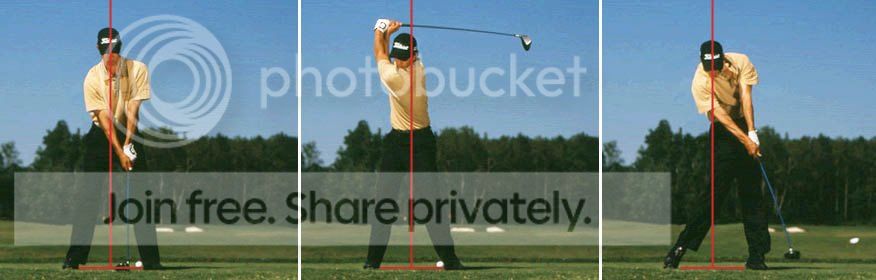 This correct approach enables the student to separate immediately fact from fantasy. Centered Head, anyone? |
What Are The Pros and Cons?
In 2-H, Mr. Kelley states that the Head Pivot Center is "recommended", but it is "not at all mandatory". That certainly sounds to me like we can have our choice of Head Center or Between the Shoudlers pivots without a lot of serious dissent from HK.
I would appreciate a discussion of the pros and cons of each and why certain players would be better served selecting one over the other. There must be reasons why the Head Pivot Center is recommended by HK, but there also must be reasons why it isn't mandatory. |
Quote:
Homer Kelley (direct quote from recorded discussion): "Centered Arc. There're some people arguing if it is the back of the neck or the head. I'll just touch on that. I advocate the head because, if you use that as your pivot center, your eyes will tell you when you have moved. You can see under the ball somewhere. Whereas, if you move your head with the back of the neck center, you have nothing there to go by. I don't think it's nearly as dependable. Geometrically, you could say it is more correct, but I have come to some information that says that it is not all that correct or effective either. So, you have to have a stationary Head." |
Could the eyes be the Center? or is that just looking to deep into the subject here!!! Last I checked they are located in yer head..on most people one on each side there head...
|
I don't think it can be judged from one pic guys....that is "more of" a "tripod"....
But I've seen pics of Adam where his head moves more to his right.... http://redgoat.smugmug.com/gallery/81493/1/2831298 Not trying to rain on anyone's parade because I want to....just posting what I see. If you find another one that shows a "tripod"...plese post it. (everyone) |
All You Can Do Is All You Can Do
Quote:
The Head is dead-center at Address, dead-center at the Top and dead-center at Impact. Indeed, what "more" could be asked? If you have "seen pics of Adam where his head moves more to his right" -- and assuming you actually are seeing what you think you are seeing -- then Adam Scott has Swayed. But this time 'round, he is has not. The sequence stands on its own merit. Learn from it. |
Posted by Matthew:
Homer Kelley (direct quote from recorded discussion): "Centered Arc. There're some people arguing if it is the back of the neck or the head. I'll just touch on that. I advocate the head because, if you use that as your pivot center, your eyes will tell you when you have moved. You can see under the ball somewhere. Whereas, if you move your head with the back of the neck center, you have nothing there to go by. I don't think it's nearly as dependable. Geometrically, you could say it is more correct, but I have come to some information that says that it is not all that correct or effective either. So, you have to have a stationary Head." End of post by Matthew Would you agree with this Mr. Blake? |
Lynn...
That doesn't look "dead center" to me (at the top)....(sorry)... What happened to "precisely" between the feet? (you said it not me) It's close... ... And besides.... Is this not the pic that has been altered? If it is the original DID have the head further back... Given, it WAS on a slope....but I think that in itself might just make it to be not be a good picture to judge, period. (and it IS only ONE picture...we need more when it's this close- I think) What do you think? .... BTW I realize that "Swaying" is a Snare in The Golfing Machine....and I definitely respecet and hold Homer Kellys 50 (or w/e) years of research in very high value....but lots of great golfers Sway then.....(and hit it with a very high level of precision- and power). I just don't think that's an overly bad thing. (esp. with a mid-longer club in your hands....or if you're a slicer or learning to pivot) I mean.....I'm not advocating a LARGE degree of Swaying....cause you can overdo anything....in MY OPINON though....a little is more than fine. (IMO people) ... I love Homer's work....but I also like to form my own opinions (please no "He did it for 50 years vs. your 10" argument)....and there are tons of options....I think that's important. ... One more thing I'd like to address... To me....a perfectly stationary (i.e. no movement at ALL) and CENTERED (between the heels) head IS ideal for a machine...(the book is called "The Golfing Machine"...)....but are people built like machines? Possible that Homer may not have weighed this (human anatomy) as heavily as he should have? (although there is no doubt that in his 50 years or so of reasearch he thought of it) What do yall think? He WAS still researching.... (and you still have options anyway...even according to him) |
One more thing...
"They are both the same because the Head includes the Base of the Neck" (that is from the poll above) ... How is the head the base of the neck? From my understanding, the "base of the neck" is the bottom of the neck.....i.e. between the shoulders. |
In post #74, Mathew offers one possible advantage to the Head Center Pivot -- you can tell if you moved your head because you can see under the ball more.
Is that the only advantage? |
| All times are GMT -4. The time now is 07:55 PM. |