
|
Quote:
|
Letting Go
Quote:
However, I don't believe I have answered your question in the context you mean it. As you refering to Release Motions in 4-D-0 and the Sequenced Release of the Swinger or the normally employed Swinger's Three Barrel (4-2-3) Total Motion Stroke Pattern (in which case the Release of #4 would precede #2)? |
Lynn and Jeff, the problem that I see is that if we want to start the takeaway with the rear forearm in line with the shaft is that:
- either the arm is too bent in elbow and the ball position too much forward without any cock of the wrist at address - or one needs to execute an impact fix position at address with a relatively strong RH grip. I believe that is why e.g. Hogan was perfectly aware that both are unefficient methods of addresing (vide: "5 Lessons") and he accepted the fact that the rear forearm magic start to act exactly when the golfer returns to the elbow plane during downswing - the sooner the better. Just my 2 eurocents :) Cheers |
Quote:
4-D-0 that you mentioned and this is where I came up with the Release beginning when #2 starts to release. BUT what I am really after, in case your answer is different would be for a 4,2,3 Three Barrel swing. The question for this is "When should the right forearm begin to be on-plane" ? |
Quote:
I think many of us understand where it must be at times, but not all the time, and that incomplete understanding leads to fog/confusion. Further, I think we would benefit from understanding 'RF alignment through the swing' of pro players whose RF's are not on plane with the shaft at address. |
Yoda - you wrote-: "the Right Forearm supports the On Plane Loading".
You are right. I forgot about that point. I now recall one of your archived posts where you wrote about a strut supporting an airplane wing (which is a good analogy). To summarise what is meant by the term "Magic of the Right forearm" it includes-: 1) The right forearm supports the on-plane loading of the primary lever assembly in hitters and the secondary lever assembly in swingers. 2) It acts together with the bent right wrist and PP#3 to keep the clubshaft on-plane throughout the entire downswing (via tracing the SPL action). 3) It gets on-plane as it paddlewheels into impact thus supporting the clubshaft at impact. I think that one can see the 'magic of the right forearm" in action in Stuart Appleby's swing. http://au.youtube.com/watch?v=_jqJ9R2LypY&NR=1 I produced the following series of capture images from that video and highlighted the right upper limb in red so that one can concentrate one's visual attention on the right forearm. Backwsing 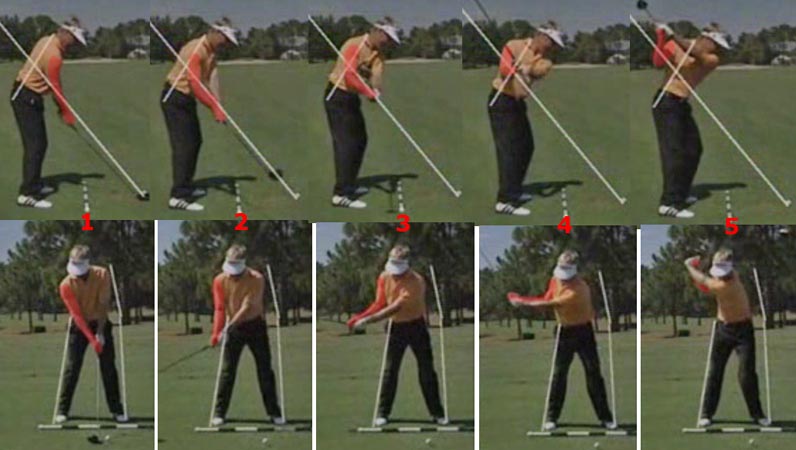 It looks like he is using a right forearm takeaway in images 2 and 3. It looks like his right forearm is supporting the load of the secondary lever assembly in image 5. Image 4 shows how the right forearm takeaway can keep the clubshaft on-plane during the mid-backswing. Downswing 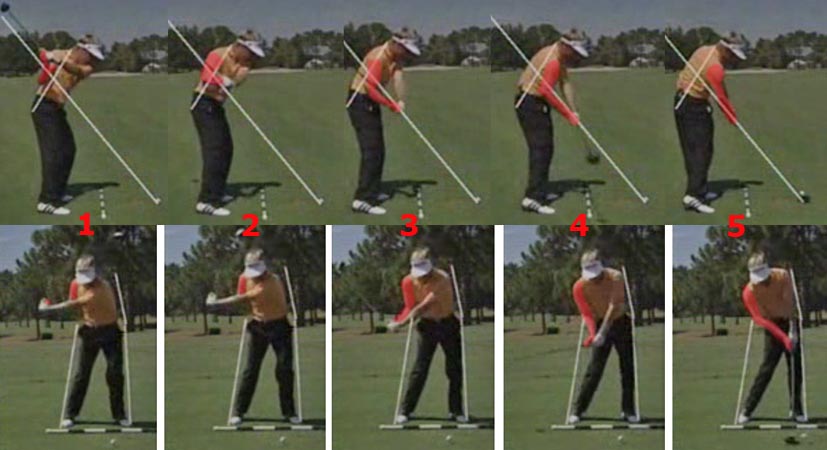 Images 1, 2 and 3 show how the right forearm acts to keep the clubshaft on-plane during the downswing. Images 4 and 5 show how the right forearm paddlewheels to an on-plane position behind the clubshaft as it nears impact. Jeff. |
Visual Feet To the Fire
Quote:
:salut: |
| All times are GMT -4. The time now is 12:11 AM. |